The Origin & Regional Context
Resting in the lower Dhauladhar foothills where the plains of Punjab meet the mountains, the small Rajput kingdom of Nurpur (formerly Dhameri) nurtured a lyrical school of Pahari painting. Renamed after Mughal Empress Nur Jahan in the 17th century, the state maintained close diplomatic ties with the plains while guarding its mountain solitude.
Under rulers like Raja Jagat Singh and Raja Mandhata, and reaching its artistic maturity in the late 18th century under Raja Prithvi Singh (r. 1735-1770) and Bir Singh (r. 1789-1846), Nurpur developed a distinctive painting atelier. The artists of Nurpur absorbed the fluid draftsmanship of nearby Guler and Kangra, but chose a gentler, more intimate scale. In Nurpur, the pastimes of Braj were moved into private mountain arbors, where flowering willows dip over running streams and the cowherd god is welcomed as an intimate mountain companion.
Visual Grammar & Iconography
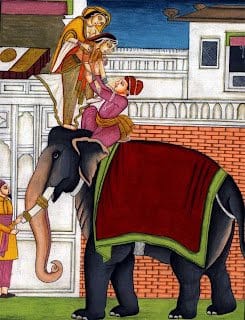
Nurpur painting is recognized by its delicate figures, pale pastoral grounds, and tender emotional reserve:
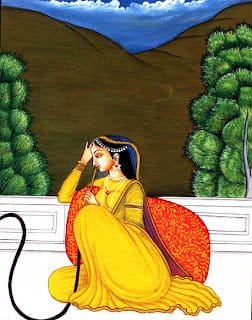
- The Modest, Slender Profile: Figures are unusually delicate and graceful. Radha is drawn with a high sloping forehead, long crescent-shaped eyes, and a sensitive, downcast chin expressing modest devotion (lajja).
- The Graceful Weeping Willow: Nurpur masters had a unique affection for the willow tree. Slender, drooping willow boughs with individual narrow leaves frame the figures, echoing the curve of Radha’s body as she turns toward Krishna.
- Pale, Lyrical Color Harmony: The atelier abandoned the fiery reds of Basohli. Compositions are washed in pale sage greens, cool slate blues, creamy ivories, and soft primrose yellows, accented only by Krishna’s glowing saffron pitambar.
- Intimate Architectural Niches: Scenes are frequently set within simple low wooden fences, grass huts, or small whitewashed hillside pavilions, creating an atmosphere of seclusion.
Material Anatomy & Process
The creation of Nurpur miniatures followed classical Pahari methods:
- Handmade Sialkoti Wasli: Dense layers of smooth mountain rag paper were bonded with starch paste, treated against silverfish using neem, and burnished with hard river agates.
- Squirrel-Hair Brushes: Brushes trimmed to two or three hairs allowed artists to lay down delicate single-hair lines for willow leaves and transparent draperies.
- Natural Mineral Palette
- Green: Soft terra verde mixed with vegetal juice for weeping leaves.
- Yellow: Local mountain peori and raw orpiment (haritala).
- Blue: Lapis lazuli washed down to translucent sky tones.
- White: Pulverized conch shell and zinc white.
The Literary & Spiritual Roots
The emotional heartbeat of Nurpur painting was rooted in Vaishnava poetry:
- The Bhagavata Purana: The tenth book of the Bhagavata was the primary text illustrated by the court workshop, focusing on Krishna’s pastoral youth, the protection of the cattle, and intimate forest conversations.
- Jayadeva’s Gita Govinda: Illustrated suites interpreted Jayadeva’s verses through the lens of quiet mountain romance, portraying Radha’s yearning with restraint and tenderness.
- The Mood of Tenderness (Vatsalya and Madhurya): In Nurpur, devotion was gentle. Krishna was painted not as a remote monarch, but as the beloved child and companion whose presence turns every mountain path into Vrindavan.
Heritage, Lineage & Field Notes
- The Artist Lineages: Master artists connected to the family of Pandit Seu worked between Guler and Nurpur, creating subtle stylistic bridges between the two principalities.
- The Fort at Nurpur: Historic frescoes inside the Brij Raj Swami Temple within Nurpur Fort remain one of the rare places in India where Krishna is worshipped alongside an image of Meera Bai.
- Key Archival Repositories
- Government Museum and Art Gallery, Chandigarh: Premier holdings of Nurpur folios.
- National Museum, New Delhi: Master leaves from the Nurpur Bhagavata cycles.
- Bharat Kala Bhavan, Varanasi: Important selections of late 18th-century Nurpur paintings.
In Nurpur, the painters understood that love is deepest when spoken softly. They draped the love of Braj in mountain willow boughs, where every leaf hangs in quiet contemplation of the divine.