The Origin & Regional Context
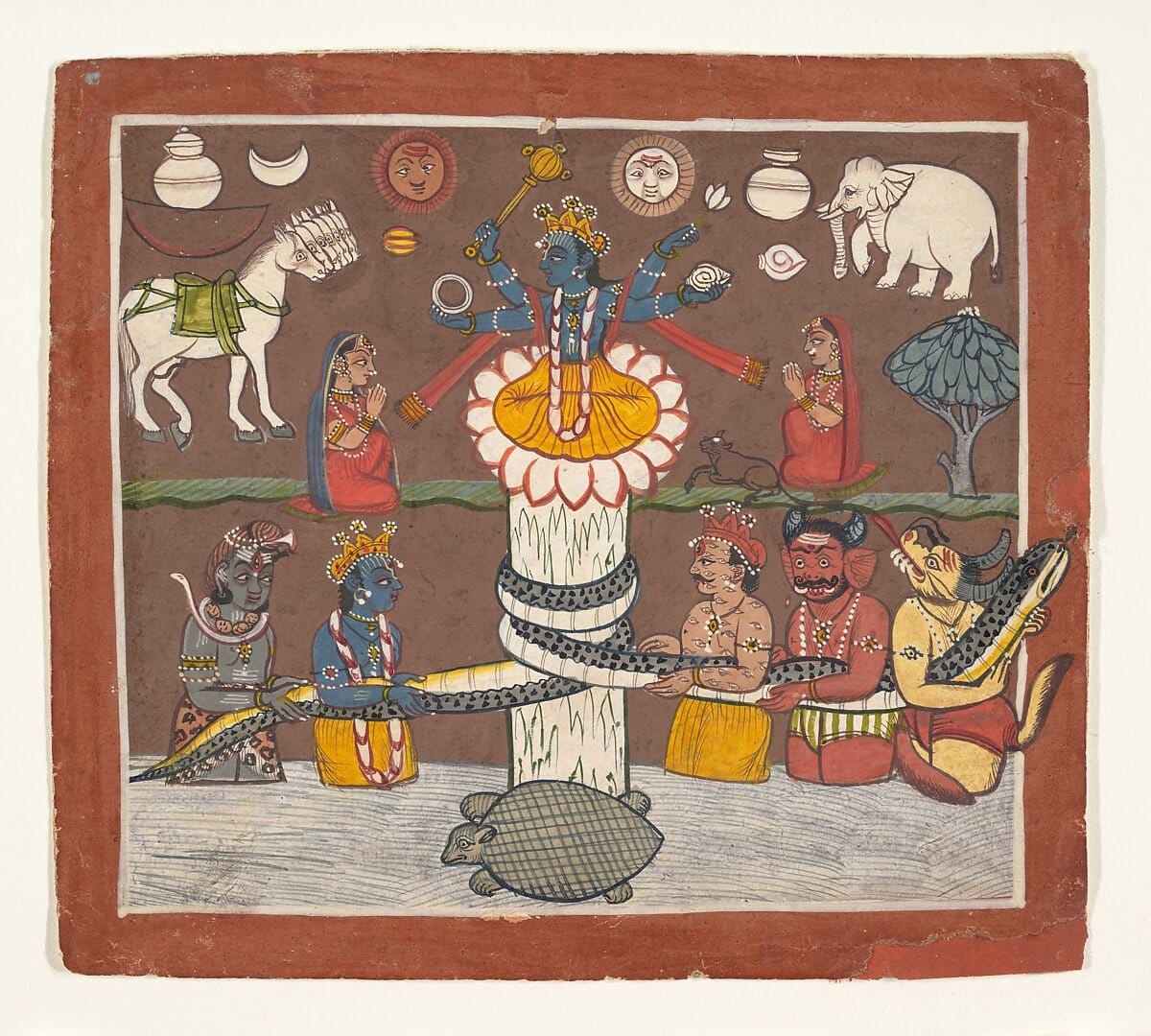
Set deep in the Beas River valley and ringed by the rugged Dhauladhar mountains, the hill kingdom of Mandi developed an artistic temperament completely distinct from the delicate courts of Kangra or Guler. Mandi was a realm steeped in Shaivite ascetics, Tantric rites, and ancient folk worship.
Under rulers like Raja Sidh Sen (r. 1684-1727), a king famed for his physical stature and mystical Tantric leanings, Mandi’s painters developed an intense, heavy visual style. However, in the late 18th and early 19th centuries, under Raja Ishwari Sen (r. 1788-1826), the court turned passionately toward Vaishnavism. When master painter Sajnu arrived from Kangra around 1808, he brought the lyrical narratives of Braj into Mandi's studio. Yet Sajnu did not soften Mandi's voice; instead, he combined Kangra’s romantic poetry with Mandi’s ancient, earthbound power, creating an intense vision of Krishna’s pastoral play.
Visual Grammar & Iconography
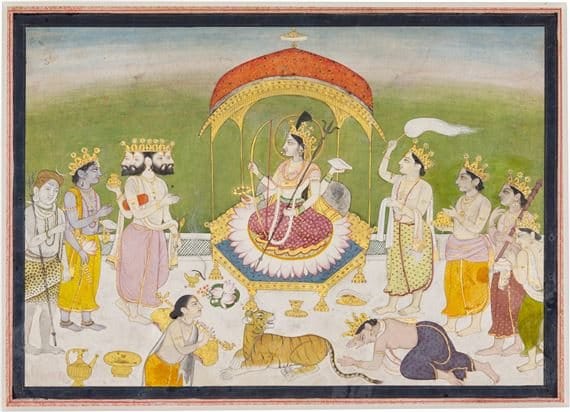
- The Deep, Heavy Earth: Compositions are grounded on high, rising fields of solid, saturated color, often a deep beetle-green, moss green, or dark turmeric yellow. Figures are placed firmly on the earth, giving the narrative an unshakeable physical reality.
- Exaggerated Botany: Foliage is not naturalistic; it is expressive and stylized. Towering plantain trees feature broad, curling yellow-green leaves; weeping willows fall in heavy geometric curtains; and blossoming creepers snake around gnarled trunks like living serpents.
- The Compact, Expressive Figure: Figures in Mandi possess broad foreheads, heavy jaws, rounded faces, and large, wide-open eyes that look straight ahead with intense presence. Krishna is portrayed with a robust, energetic physique, crowned with tall peacock feathers that pierce the upper borders of the frame.
- Geometrical Compartments: In narrative cycles like the Bhagavata Purana, the sheet is often divided into dynamic zig-zag clearings or stepped rocky enclosures, organizing simultaneous pastoral actions within a single sheet.
Material Anatomy & Process
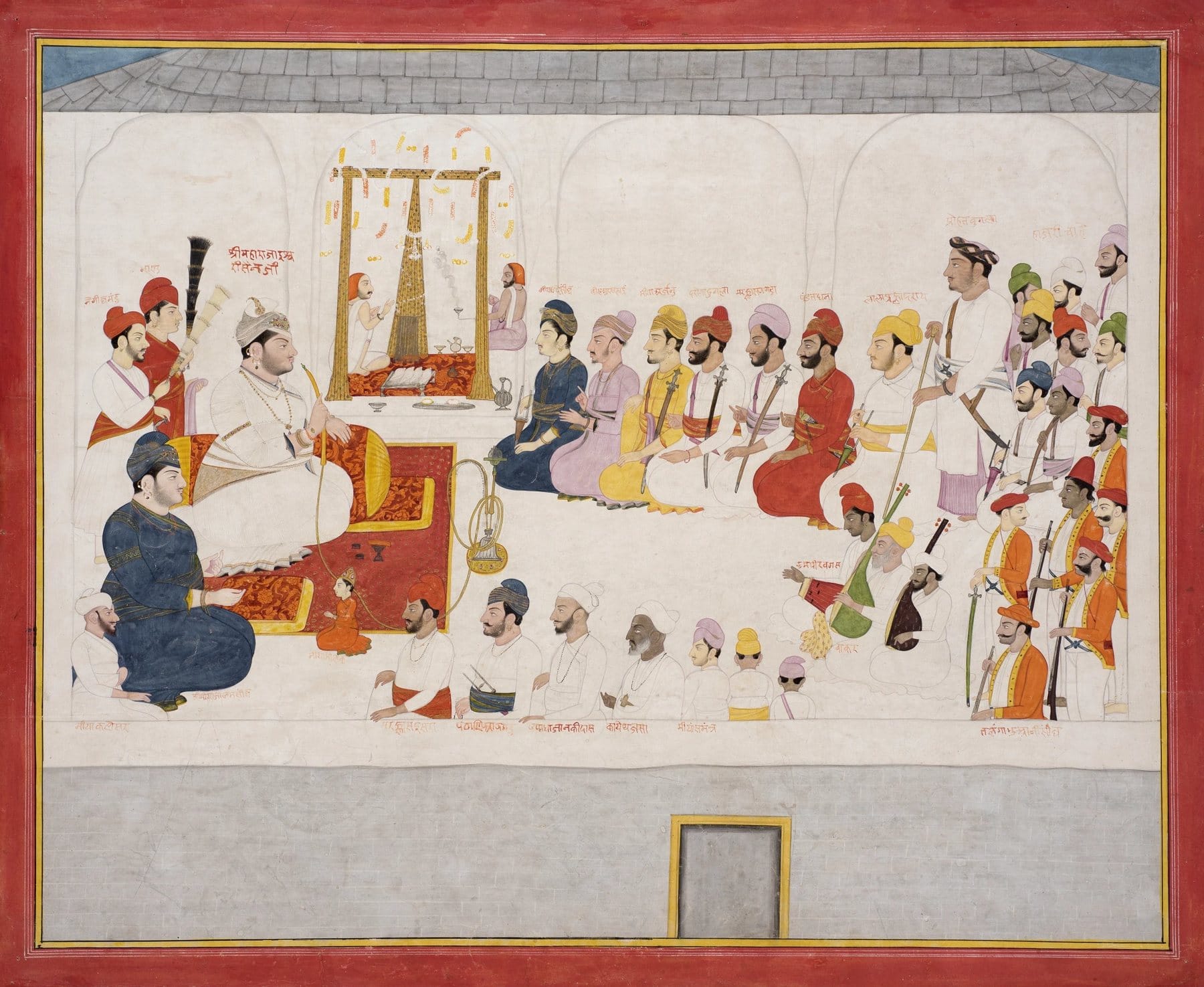
- Stiff Himalayan Wasli: Local paper makers (Kagazis) produced thick, fibrous rag paper from wild mountain plants. Multiple sheets were glued with thick cooked starch paste, creating a heavy, stiff board that could support dense layers of mineral tempera without buckling.
- Opaque Tempera Application: Unlike the translucent washes of Guler, Mandi painters applied pigments in heavy, completely opaque coats:
- Green: Thick malachite and ground copper verdigris (zangar), laid down in dark, mossy planes.
- Yellow: Piercing orpiment (haritala), applied with deliberate thickness on Krishna’s pitambar.
- Blue: High-grade indigo and deep lapis lazuli, giving Krishna’s form a nocturnal presence.
- Red: Pure mineral cinnabar (hingula) for pavilion borders and textiles.
- Bold Black Ink Drafting: Outlines were drawn with strong, confident strokes using brushes made from coarse squirrel hair, prioritizing raw character over delicate precision.
The Literary & Spiritual Roots
Mandi painting was rooted in the Tenth Book of the Bhagavata Purana and the lyrical verses of the Gita Govinda:
- The Pastoral Miracles: Mandi ateliers favored scenes where divine power was unveiled in the forest: the subduing of Kaliya, the lifting of Govardhan, and the theft of the gopis' clothes (Vastra Harana). These stories resonated with a mountain culture that understood nature as an overwhelming, living force.
- Sajnu’s Hamir Hath & Bhagavata: Sajnu illustrated both heroic ballads and intimate Krishna poetry, demonstrating how the protective power of divinity could seamlessly blend with the tender moods of Radha and Krishna.
- The Synthesis of Tantra and Bhakti: In Mandi, devotion carried the intensity of a sacred rite. The pastoral groves of Vrindavan were approached not as idyllic pastoral playgrounds, but as charged, sacred spaces where the soul confronts the absolute reality of God.
Heritage, Lineage & Field Notes
- The Master Sajnu: Sajnu’s arrival in 1808 marked the high point of Mandi's late golden age. His complex compositions, signed folios, and energetic characterizations established a family atelier that continued into the mid-19th century.
- The Mandi Darbar Dispersal: The royal collections remained housed within the Raj Mahal at Mandi until the mid-20th century, when major folios were acquired by Indian and international public collections.
- Key Archival Repositories:
- National Museum, New Delhi: Masterworks of 18th-century Mandi Bhagavata Purana suites.
- Government Museum and Art Gallery, Chandigarh: Outstanding holdings of Mandi paintings collected across the Punjab Hills.
- Metropolitan Museum of Art, New York: Rare early Mandi folios depicting the childhood pastimes of Krishna.
In Mandi, the forest did not whisper; it stood tall, rooted and alive. The painters showed that the love of Braj was strong enough to anchor itself into the deepest rock of the mountains.