The Origin & Regional Context
Mewar was the iron spine of Rajput resistance. While other courts made early peace with Delhi and adopted Persian courtly mannerisms, the Maharanas of Udaipur held their mountain passes at enormous human cost. When peace finally came under Maharana Jagat Singh I (r. 1628-1652), the court’s creative explosion was not secular or decorative; it was intensely, unapologetically devotional.
At the center of this movement was a Muslim master painter named Sahibdin. Working in the royal atelier at Udaipur between the 1620s and 1650s, Sahibdin was commissioned to illustrate the great sacred libraries of India: the Ragamala, the Ramayana, the Rasikapriya, and decisively, the Tenth Book of the Bhagavata Purana (1648). Sahibdin did not adopt the misty, atmospheric perspective of the Mughal court. Instead, he took the ancient, indigenous visual grammar of Western India and fortified it with bold, impassioned fields of color, giving Braj an indestructible visual architecture.
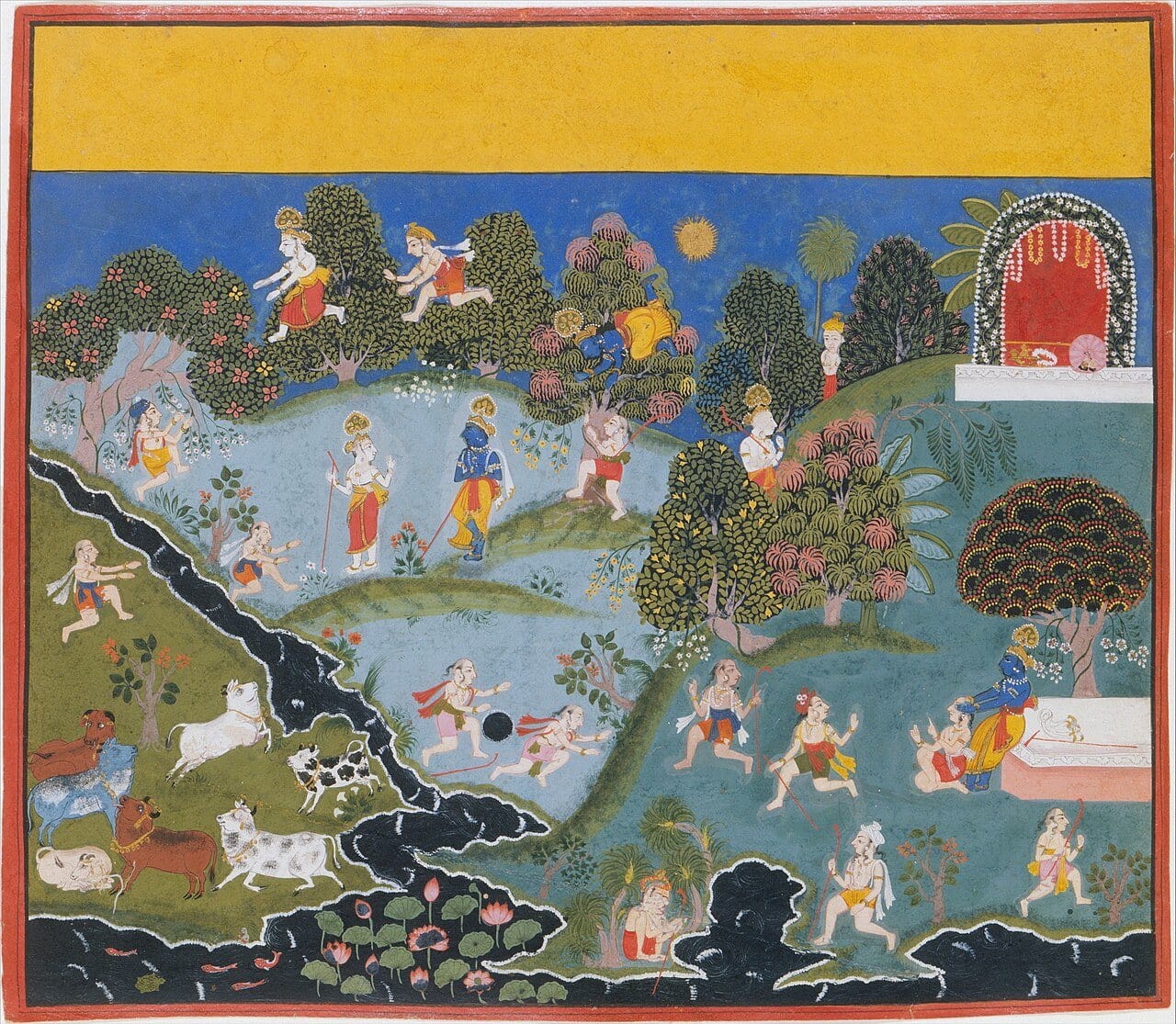
Visual Grammar & Iconography
Sahibdin's visual universe is rigorous, direct, and emotionally pure:
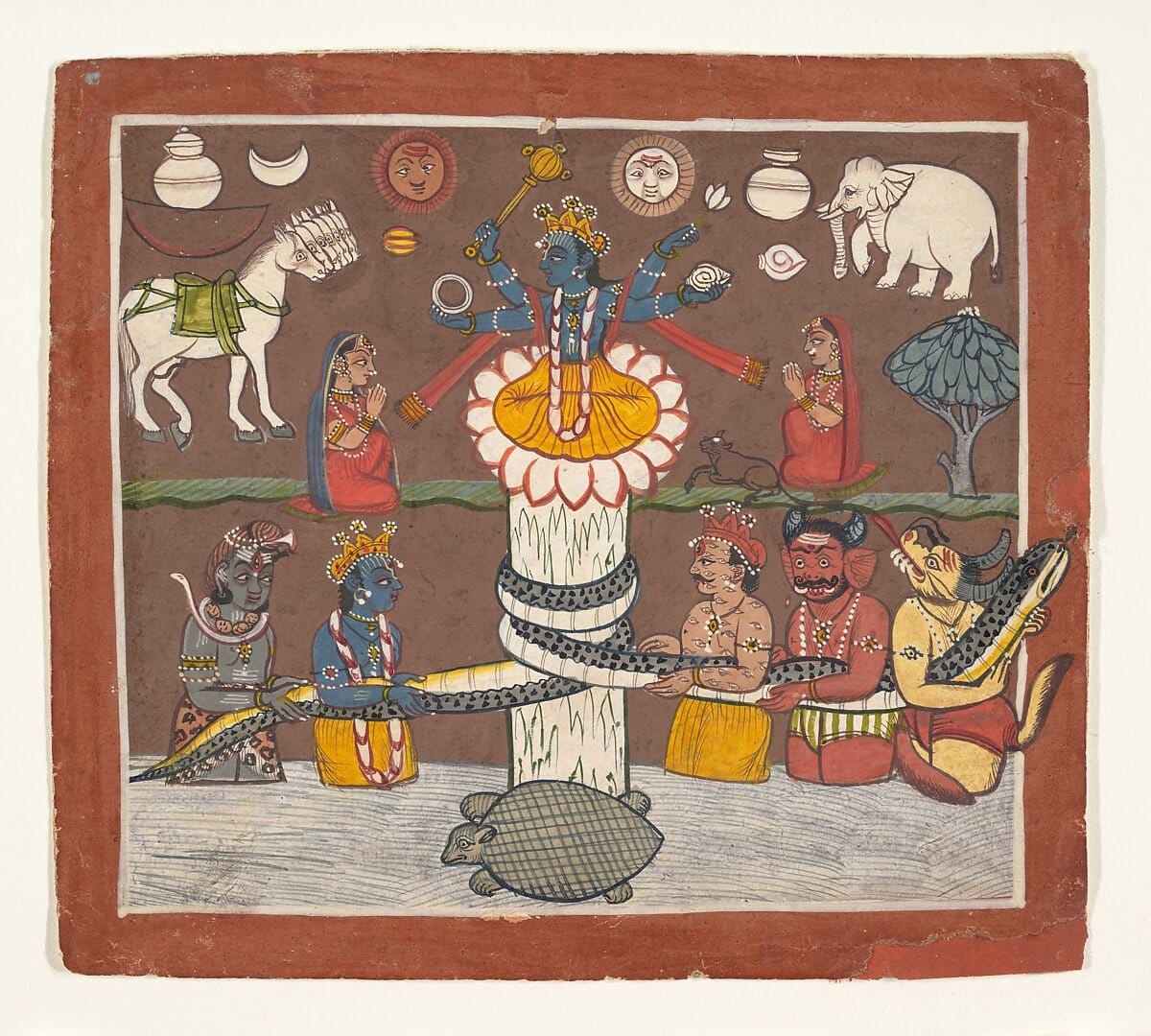
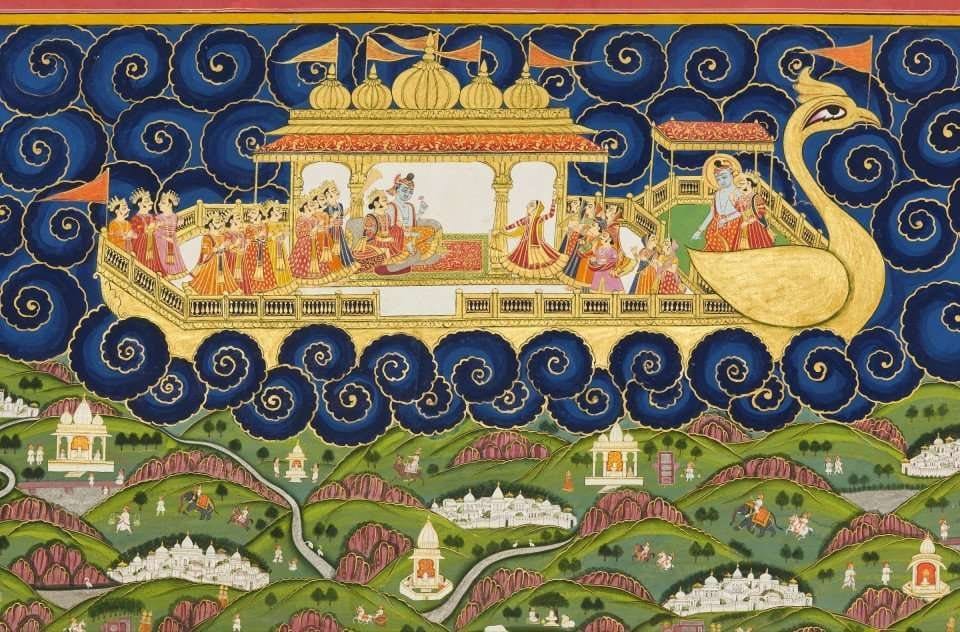
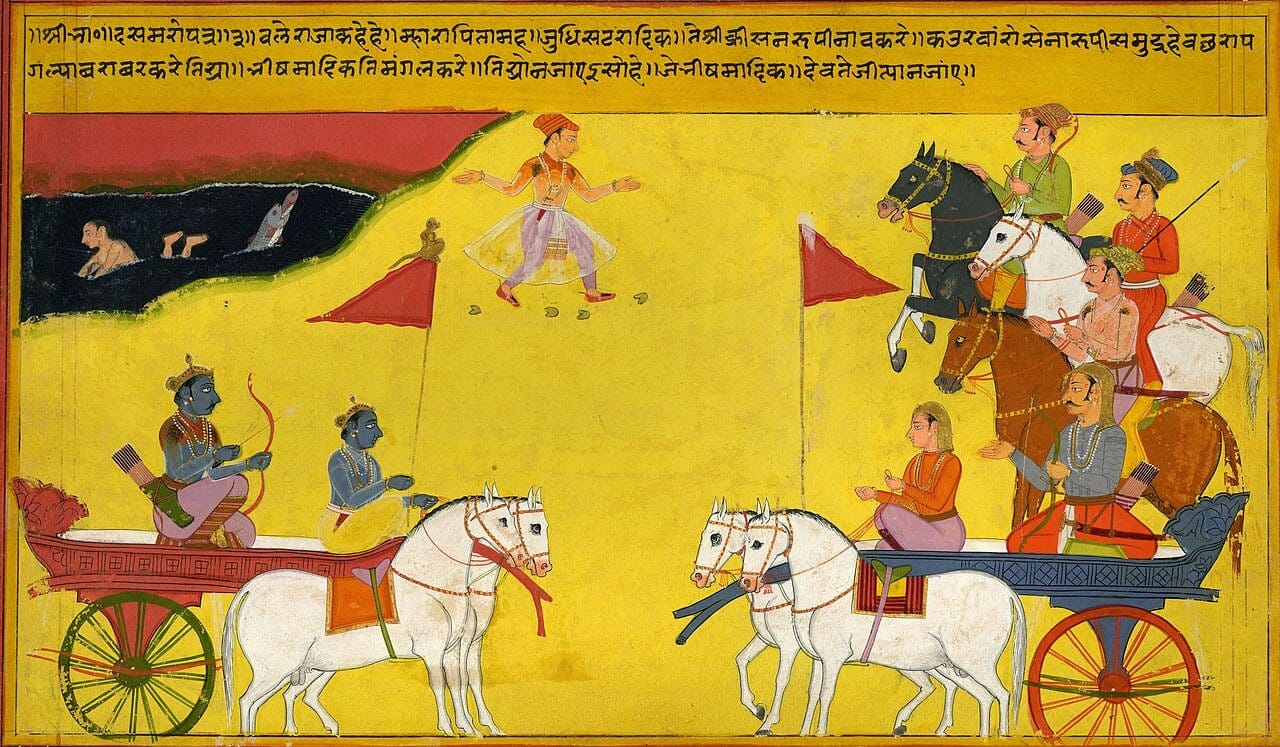
- Saturated Monochrome Grounds: Compositions are broken into high-contrast geometric fields of solid, unmodulated color: blistering cinnabar red, mustard orpiment yellow, deep chocolate brown, and nocturnal indigo. These color blocks do not represent real physical walls; they represent emotional chambers (bhavas).
- Continuous Narration (Synoptic View): Time in Mewar is not frozen in a single camera snapshot. Across one page, Krishna may appear three times: first stealing butter in a courtyard, then running past a brick wall, and finally laughing in Yashoda’s lap. The story flows across the sheet like a continuous ballad.
- The Profile of Direct Gazes: Figures possess clean, sharp profiles with large, expressive fish-shaped eyes, strong jaws, and upright, disciplined postures. Gestures are dramatic and clear: an outstretched finger indicates command, while hands clasped to the chest signal complete devotional surrender.
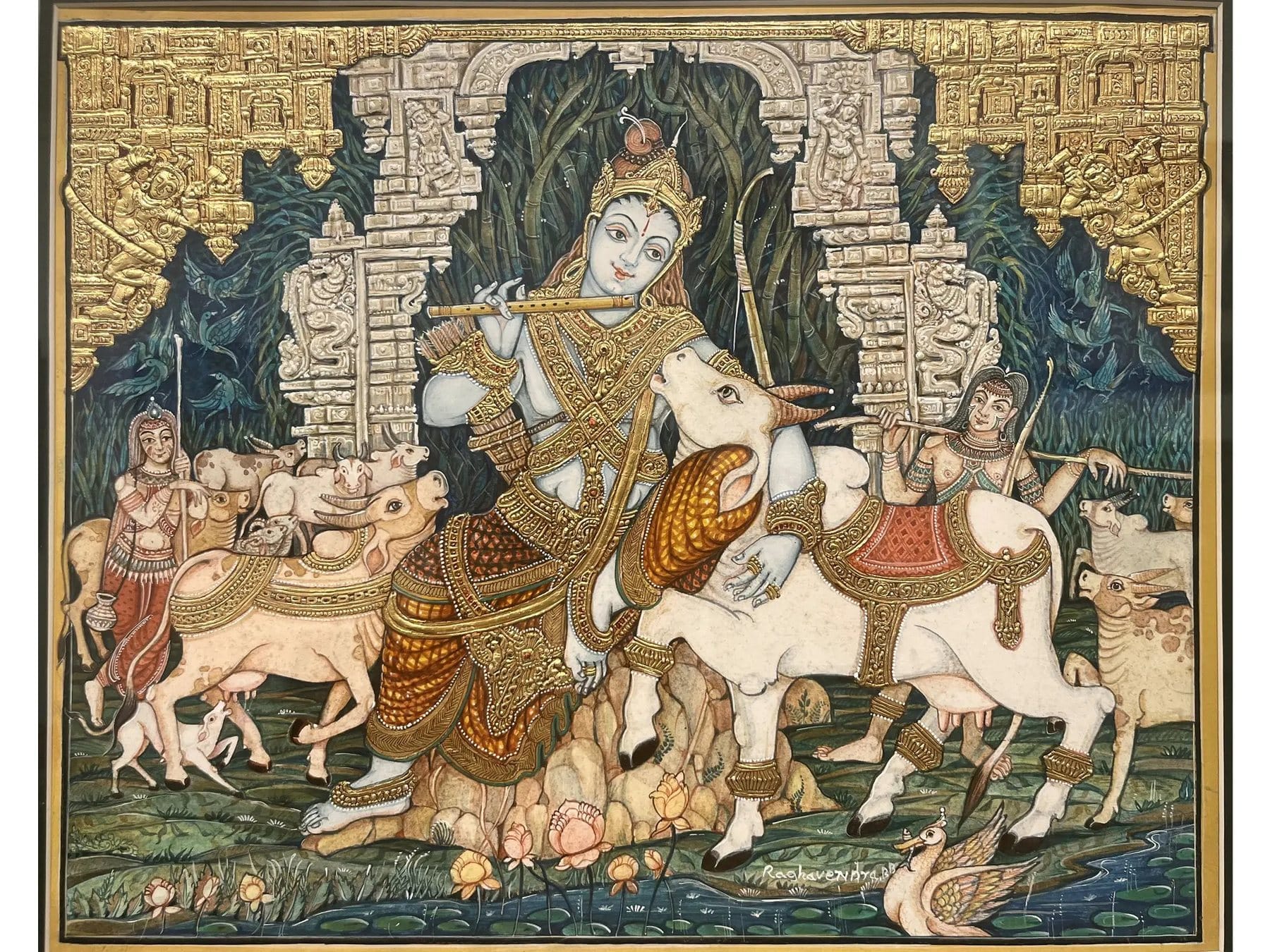
- Stylized Foliage Clusters: Trees are not painted as individual leaves. They are assembled as rounded, compact umbrellas of scalloped green, adorned with symmetrical floral rosettes and winding, white creepers that frame the divine lovers like natural sanctum niches.
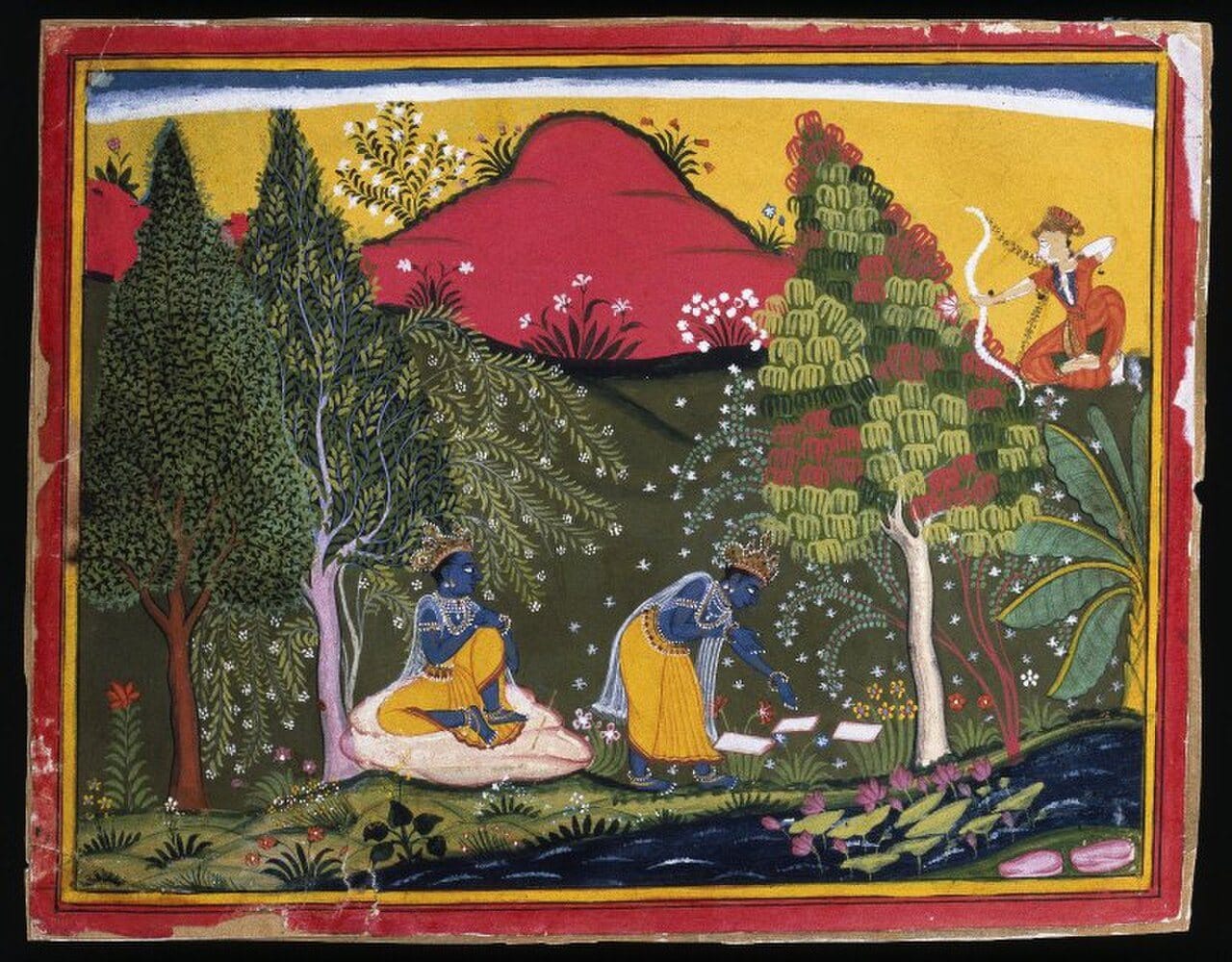
Material Anatomy & Process
The bold, unyielding permanence of Mewar paintings relies on classical tempera techniques:
- Heavy Wasli Boards: Mewar artists worked on dense, multi-layered sheets of handmade rag paper glued with starch paste, burnished with hard agate stones until the surface possessed the density and tooth of smooth wood paneling.
- Opaque Mineral Tempera: Pigments were applied in thick, opaque layers bound with babul gum (acacia arabica):
- Red: Pure mineral cinnabar (hingula), delivering an incandescent, non-fading scarlet red.
- Yellow: Toxic orpiment stone (haritala), providing a piercing, luminous saffron tone.
- White: Pulverized calcined conch shells (sankha) or lead white.
- Black: Dense lampblack collected from mustard-oil wicks, applied with razor-sharp brushes of goat hair.
- The Burnished Finish: Once completed, the reverse side of the folio was burnished with heavy pressure, forcing the thick mineral layers deep into the paper fibers so the colors retained their enamel-like brilliance without flaking over centuries.
The Literary & Spiritual Roots
Mewar painting was the visual manifestation of the Bhagavata Purana:
- The Tenth Book (Dasama Skandha): Sahibdin’s magnum opus is the 1648 Bhagavata Purana. Unlike later court paintings that favored the romantic escapades of the Rasikapriya, the Mewar suite treated Krishna’s pastimes as sacred revelation. Every cowherd, tree, and pot in Gokula is treated as an active participant in divine grace.
- Surdas and the Mewari Translation: The court scholars translated Sanskrit verses into Mewari and Braj Bhasha poetry, inscribed on the yellow bands across the top of each painting so that priests and courtiers could read the verses while holding the folio.
- The Rasa of Unshakeable Faith (Shraddha): Mewar’s color fields are not subtle because faith in Mewar was not subtle. The fierce, uncompromising reds and yellows reflect the martial spirit of a kingdom that viewed Krishna not merely as a secret forest lover, but as the supreme lord of righteousness.
Heritage, Lineage & Field Notes
- Sahibdin’s Enduring School: Sahibdin’s legacy shaped Mewari painting for over a century. His pupils and family members continued to illustrate vast mythological cycles, including the Gita Govinda, Sundarkand, and the Devi Mahatmya.
- The Mewar Dispersal: While the British Library holds the famous Mewar Ramayana, extensive folios of Sahibdin’s 1648 Bhagavata Purana were dispersed during the 20th century, with major leaves finding homes in private collections and premier global museums.
- Key Archival Repositories:
- City Palace Museum, Udaipur: The original seat of the royal collection.
- National Museum, New Delhi: Premier holdings of 17th-century Mewar Bhagavata folios.
- British Library, London: The monumental Mewar manuscript collections commissioned by Jagat Singh I.
In Mewar, devotion was built with the same unyielding strength as Udaipur’s marble bastions: painted in colors that refused to fade, in honor of a god who refused to leave.