The Origin & Regional Context
During the 18th century, as the Maratha Empire expanded under the rule of the Peshwas, the Deccan witnessed a great architectural revival. Noblemen, generals, and wealthy merchants built sprawling residential mansions known as Wadas across western Maharashtra, particularly in Pune, Satara, Wai, and Menavali.
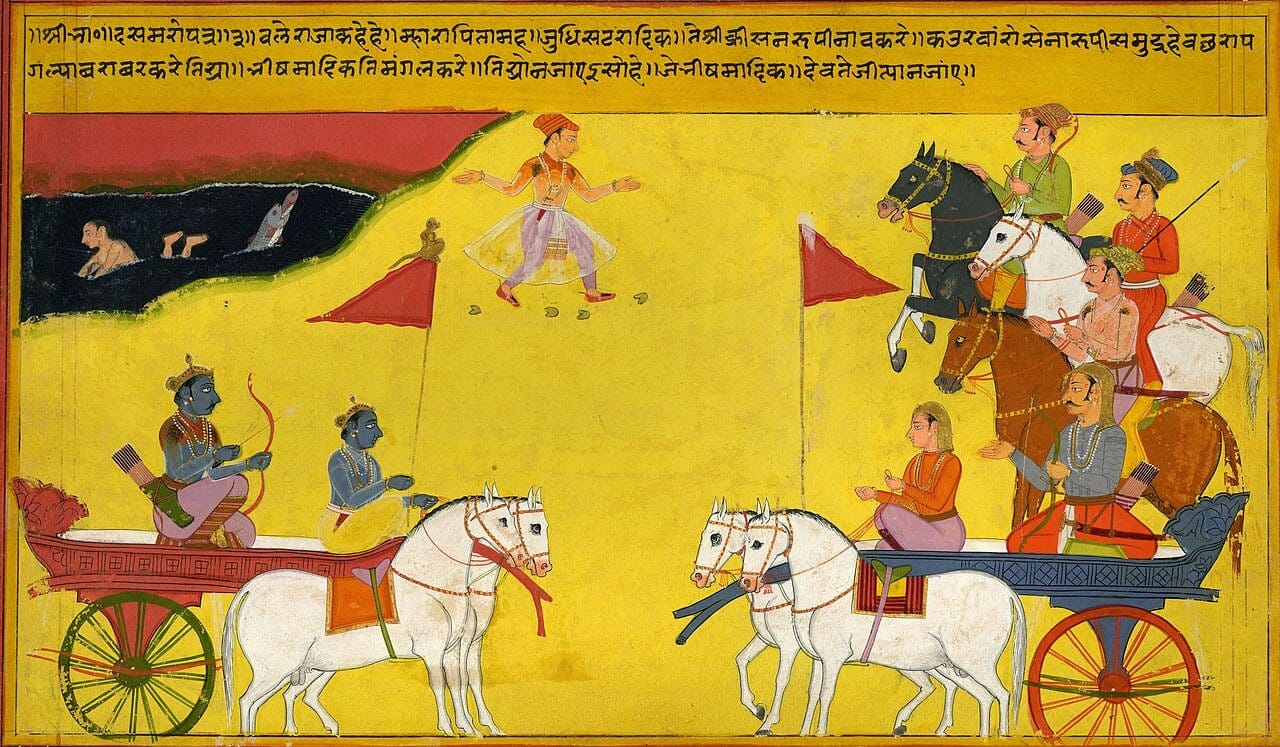
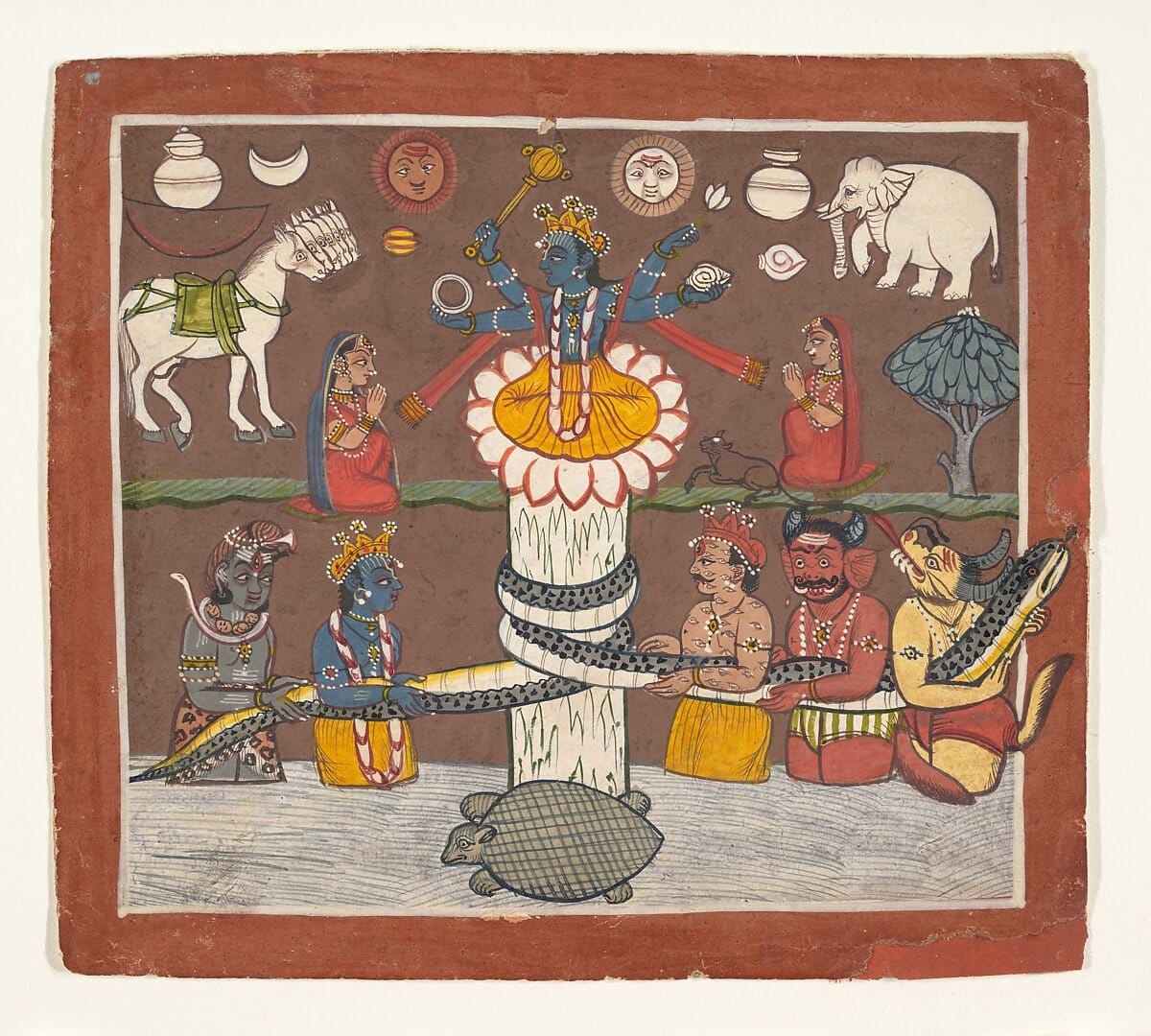
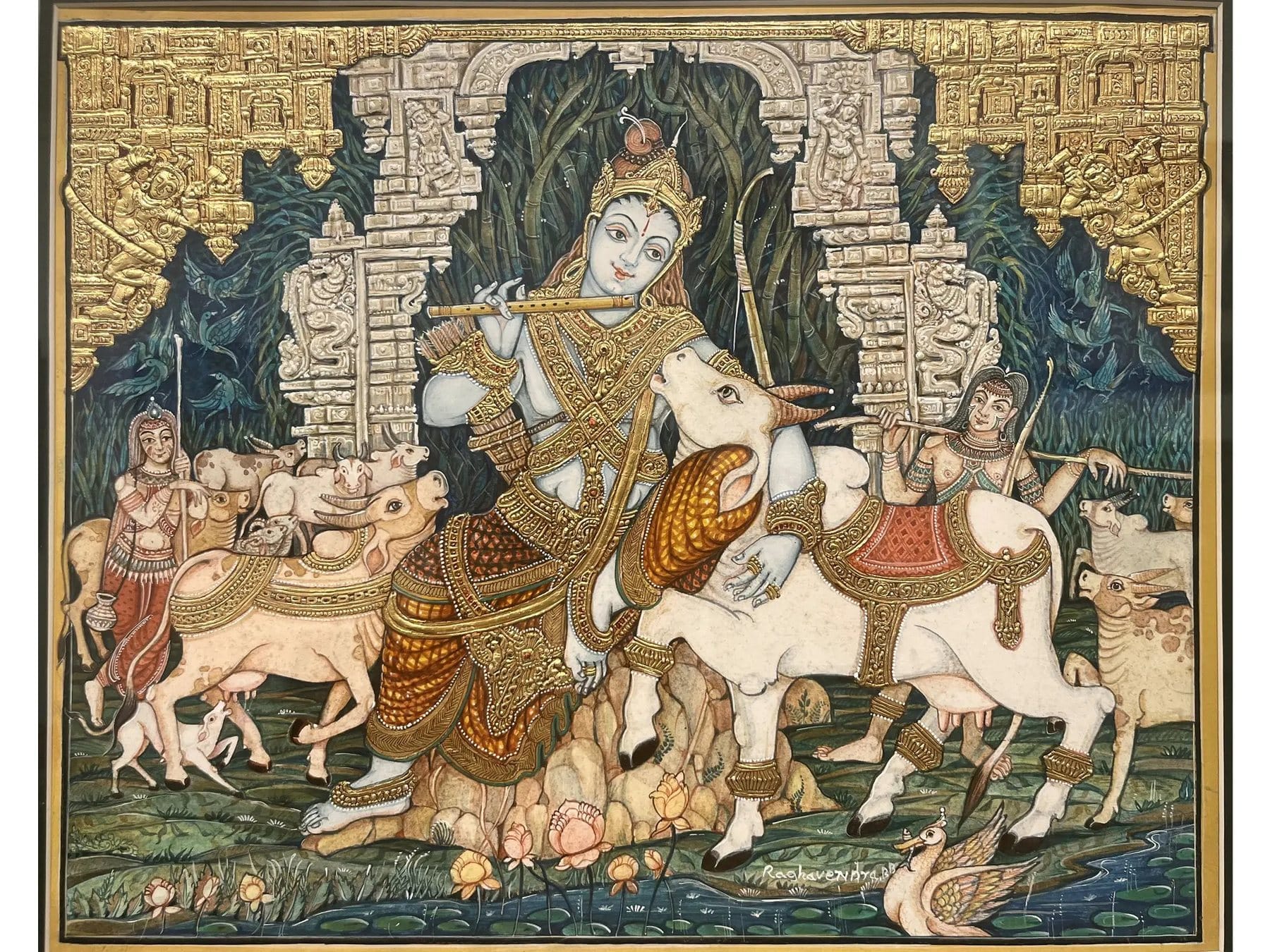
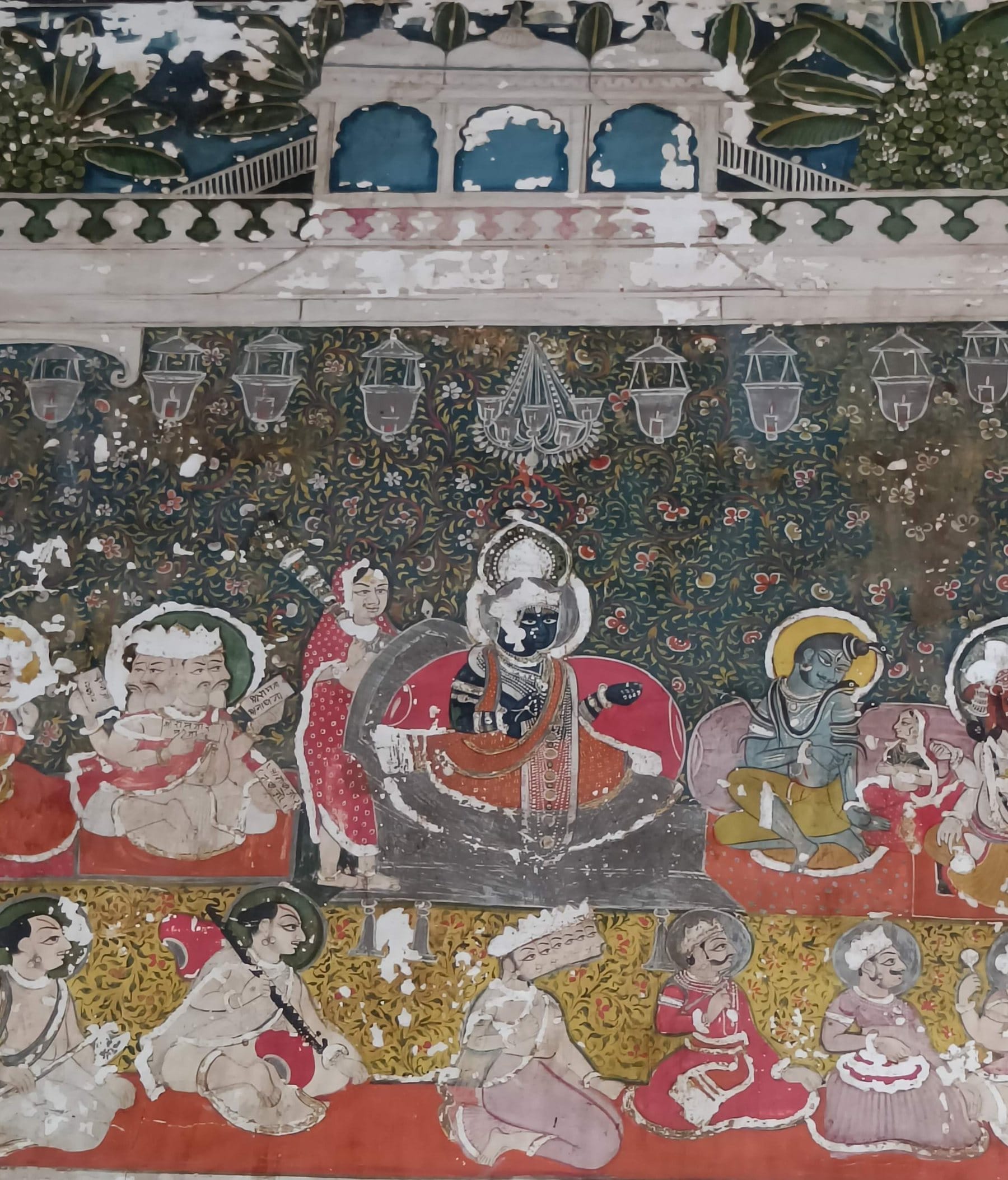
The Wada was a fortified, inward-looking domestic complex built with thick stone foundations, courtyard balconies, and heavy teakwood pillars. While the exterior presented a severe, defensive face to the world, the interior private living quarters (Majghar) and prayer rooms (Devghar) were covered in vibrant wall paintings. Influenced by traveling artists from Rajasthan and Karnataka, the Maratha nobles commissioned monumental frescoes of the epics. In the river valleys of the Krishna and Godavari, Braj entered the homes of Maratha warriors, becoming a tender sanctuary of music and devotion.
Visual Grammar & Iconography
Maratha wall painting possesses a distinctive, robust architectural rhythm:
- The Regional Silhouette: Figures reflect authentic Maratha dress and posture. Krishna is frequently shown wearing a Maratha-style turban (pagadi) or crown, while Radha and the gopis are draped in traditional nine-yard Maharashtra Nauvari sarees with rich woven borders (zari), pulled tight between the feet.
- The Monumental Panel Grid: Murals are arranged in rectangular wall niches framed by painted cusped arches, scalloped borders, and floral creepers that echo the woodwork of the house.
- Strong Linear Outlines: Paintings rely on confident, heavy black outlines that define anatomy, jewelry, and drapery with immediate clarity, ensuring that the scene remains visible in dim, oil-lit halls.
- Earthy Folk Palette: The palette relies on bold, unpretentious natural pigments: iron-red ochre (geru), lime white, yellow ochre, carbon black, and vegetable indigo, reflecting the materials of the land.
Material Anatomy & Process
The creation of Wada frescoes utilized traditional Indian fresco-secco techniques:
- The Plaster Ground: Stone and brick walls were coated with a mixture of slaked lime, fine river sand, and marble dust, enriched with organic binders like jaggery water, hemp fibres, and curd. The surface was troweled smooth until it formed a rock-hard ground.
- The Mineral Palette
- Red: Local red earth (geru) from the Western Ghats.
- Yellow: Earth ochres and turmeric.
- White: Slaked lime (chuna) and crushed shells.
- Black: Soot collected from sesame-oil temple lamps.
- The Sealing Medium: Once painted on the dry plaster, colors were sealed with thin layers of animal glue or vegetable gums, preserving the frescoes in the humid mountain climate.
The Literary & Spiritual Roots
Maratha murals were guided by regional Bhakti literature and classical Sanskrit texts:
- The Varkari Tradition: While the murals illustrate classical Bhagavata stories, they are infused with the egalitarian spirit of Maharashtra's Varkari saints: Dnyaneshwar, Tukaram, and Eknath. Krishna is viewed not as an unapproachable sovereign, but as Vithoba: the affectionate friend who stands patiently waiting for his devotees.
- Moropant’s Krishna Kavyas: The 18th-century Marathi poet Moropant lived in Wai and composed thousands of verses on the Mahabharata and Krishna’s pastimes, providing direct poetic inspiration for the murals painted in neighboring mansions.
- Domestic Devotion: In the Wada, these paintings served as the daily backdrop for family rituals, festivals, and evening story-telling, ensuring that the pastimes of Braj lived within the daily rhythms of the household.
Heritage, Lineage & Field Notes
- The Sacred Town of Wai: Known as the Dakshin Kashi, the town of Wai on the banks of the Krishna River preserves some of the finest surviving Wada murals inside the Raste Wada and neighboring historic homes.
- Menavali and Nana Phadnavis: The riverside mansion of Maratha statesman Nana Phadnavis at Menavali contains an extraordinary upper-floor reception room decorated with intact Krishna-lila frescoes.
- Key Archival Repositories
- Raja Dinkar Kelkar Museum, Pune: Major collection of salvaged Maratha mural fragments and wooden architectural carvings.
- Deccan College Post-Graduate and Research Institute, Pune: Archival documentation of historical Maharashtra wall paintings.
- The Living Wadas of Wai and Satara: Preserved in situ by private trusts and heritage societies.
In the heavy stone halls of Maharashtra, the painters proved that the love of Braj was strong enough to soften the heart of a warrior. It turned the walls of a fortress into a quiet courtyard of Vrindavan.