The Origin & Regional Context
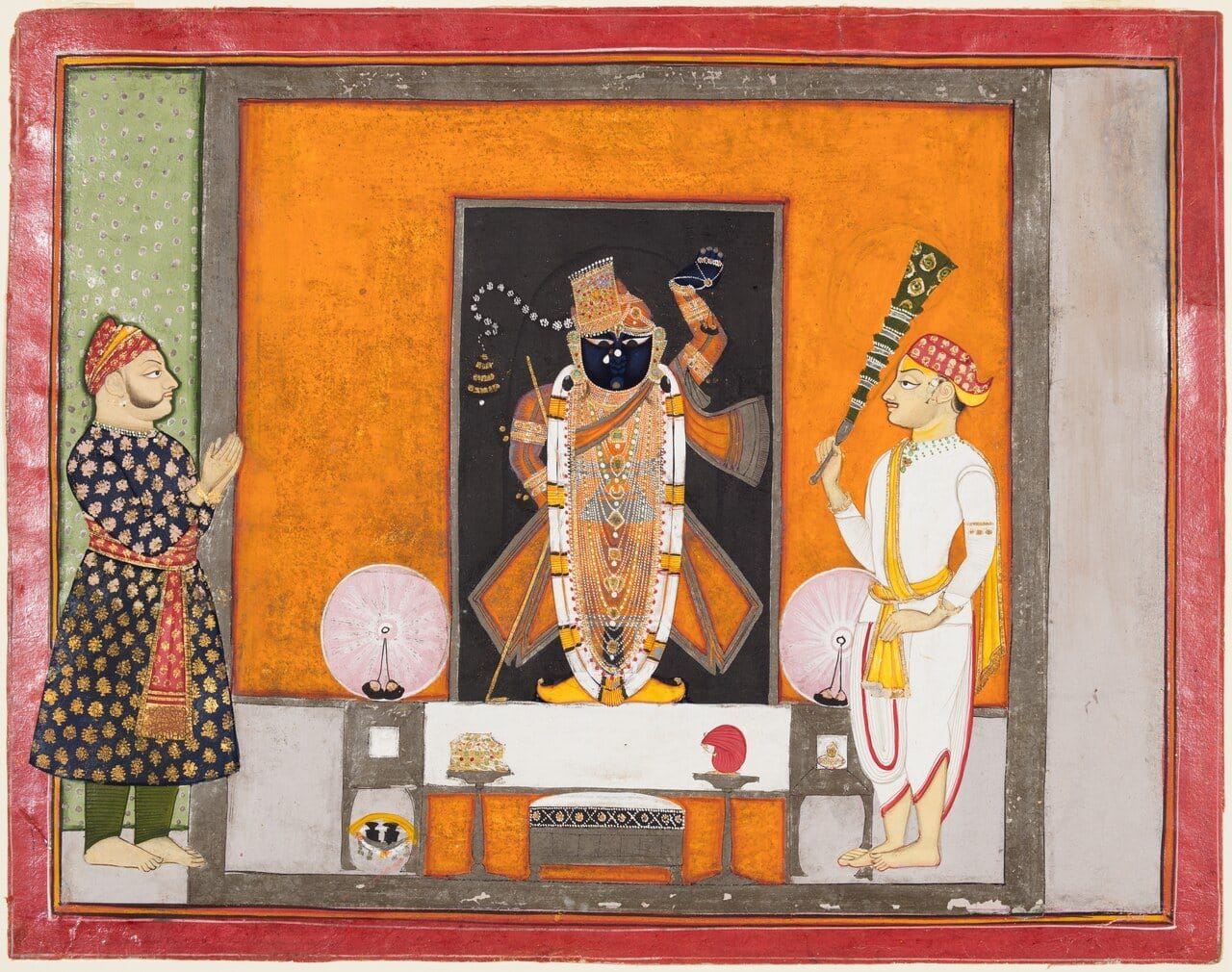
In 1631, the kingdom of Kota carved itself out from the parent state of Bundi along the rugged banks of the Chambal River. While Bundi retreated into secluded domestic courtyards to paint the soft mists of the monsoon, Kota turned its eyes outward into the wild, untamed ravines of the Hadoti plateau.
Under rulers like Maharao Jagat Singh (r. 1658-1683) and Maharao Durjan Sal (r. 1723-1756), Kota developed the most energetic, muscular hunting school in Indian court painting (Shikar scenes). Yet a profound transformation occurred under Maharao Guman Singh and his successor Maharao Umed Singh I in the late 18th century: the court formally embraced the Pushtimarg sampradaya. The Maharana dedicated the kingdom to Krishna as Mathuradheeshji, a sacred deity installed in Kota's central haveli. The ferocious hunting painters (chiteras) did not abandon their wild brushwork; instead, they recast the thorny hunting preserves of the Chambal as the sacred wilderness of Vrindavan.
Visual Grammar & Iconography
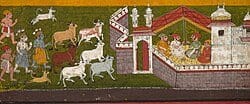
Kota Kalam is recognized instantly by its raw, kinetic movement and towering landscapes:
- The Restless, Undulating Landscape: Kota rejected the flat grounds of traditional Rajput painting. Landscapes rise in rolling, serpentine hills, jagged pinkish-gray limestone crags, and swirling ravines that sweep diagonally across the sheet.
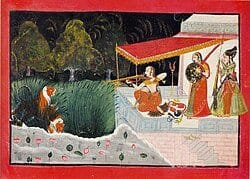
- Botanical Dynamism: Nature is not manicured. Massive banyan trees drop twisted aerial roots like hanging ropes; flowering dhak (palash) and kadamba trees explode with fiery orange buds; dense foliage is layered in deep rhythmic clusters that seem to rustle with wind.
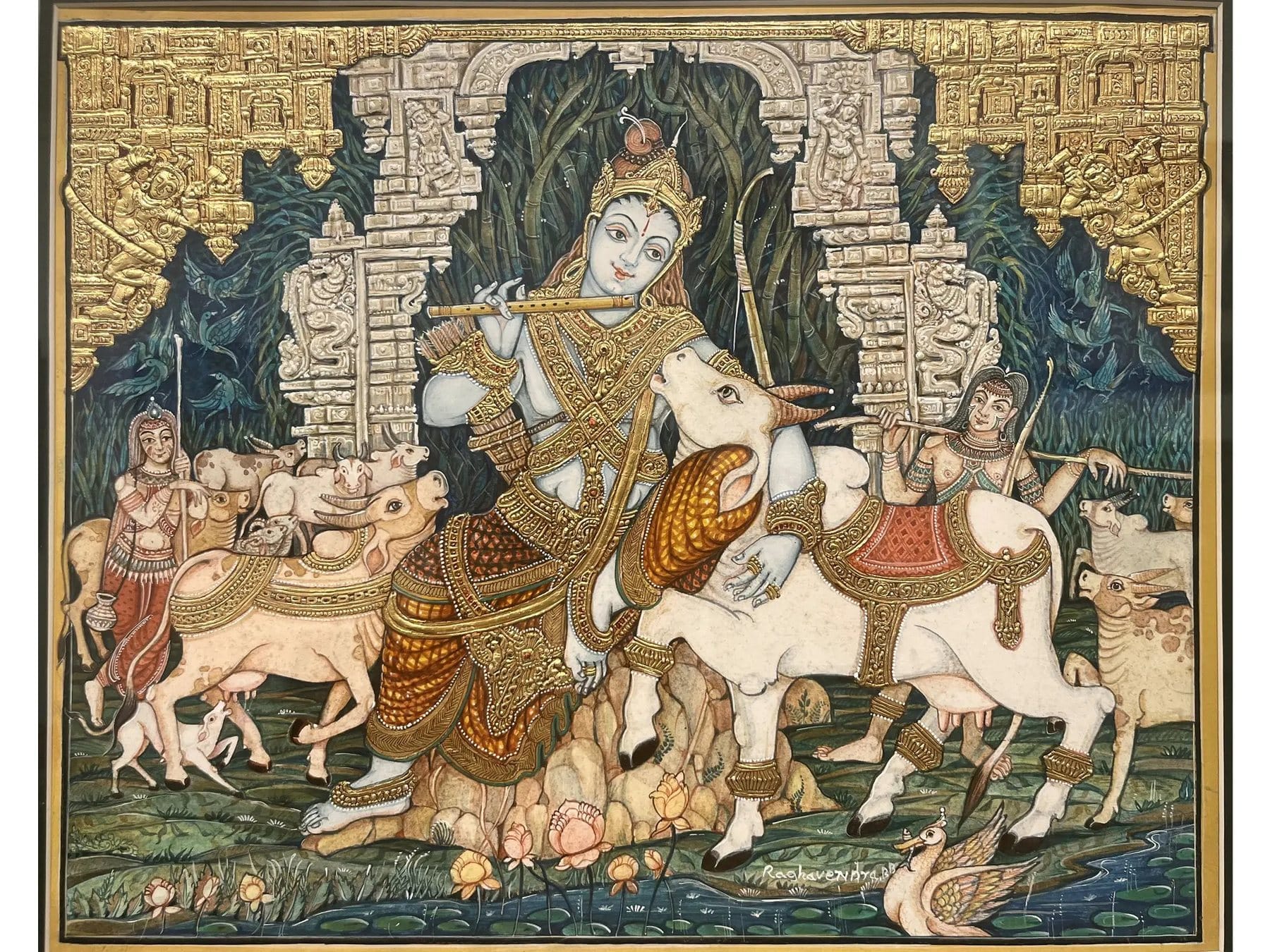
- The Muscular, Active Divine: Krishna in Kota is not a fragile courtly prince. He is an active, athletic cowherd god striding boldly through the wilderness, wrestling forest demons, or leaning against wild boughs while looking back at Radha.
- Atmospheric Birds and Game: The margins of the scene swarm with observed wildlife: startled nilgai, leaping deer, wild boars, coiled serpents, and flocks of cranes taking flight above the river.
Material Anatomy & Process
The bold, dynamic scale of Kota required distinct studio practices:
- Large-Scale Paper Sheets: Unlike delicate palm-sized miniatures, Kota artists worked on large, heavy sheets of layered handmade paper, sometimes over two feet in width, allowing the expansive forest scenes room to breathe.
- The Rapid Preparatory Brushwork: Kota painters were celebrated for their preliminary charcoal sketches (tarh) and fluid black brush drawings. The energy of the original sketch was rarely smothered by opaque pigments; it was allowed to pulse through translucent washes.
- Earth and Mineral Palette:
- Greens: Ground malachite and copper verdigris (zangar), laid in multiple tonal depths.
- Earth Tones: Local yellow and red clays from the Chambal valley, giving rocks their warm, dusty ochre glow.
- Blue: High-grade indigo and lapis lazuli for Krishna's dark complexion and swirling river currents.
- Accents: Fiery vermilion (hingul) and brilliant orpiment yellow (peori) for garments and wild palash blossoms.
The Literary & Spiritual Roots
Kota's Vaishnava painting was guided by Pushtimarg liturgy and pastoral poetry:
- Surdas and the Childhood of Hari: The verses of Surdas, celebrating Krishna’s pastimes as a young cowherd leading cattle through dense forests (Gocharan), became the primary textual justification for merging hunting landscapes with divine play.
- The Vallabhite Haveli Seva: Because Kota’s rulers dedicated their state to Mathuradheeshji, the court's daily affairs were synchronized with temple darshans. Miniature paintings functioned as visual records of the deity’s pastoral sovereignty over the state's territory.
- The Rasa of Heroic Romance (Vira-Sringara): Kota painting uniquely blended Vira Rasa (the heroic mood of the hunting warrior) with Sringara Rasa (the tender mood of Radha and Krishna), creating a vigorous devotional vision found nowhere else in Rajasthan.
Heritage, Lineage & Field Notes
- Master Lineages: Master painters like Mansa Ram, Guman, and the anonymous "Kota Master" formed hereditary workshops that passed down complex dynamic compositional templates (charbas) through generations.
- The Brijraj Bhavan and City Palace Collections: The finest examples of Kota Kalam remain housed in the Rao Madho Singh Museum within the Kota City Palace, where intact albums of both hunting records and Krishna lilas are preserved.
- Key Archival Repositories:
- Kota City Palace Museum (Rao Madho Singh Trust): The core historical repository.
- National Museum, New Delhi: Masterworks of late 18th-century Kota Krishna narratives.
- Metropolitan Museum of Art, New York: Extensive holdings of dynamic Kota hunting and mythological landscapes.
Kota did not tame the wilderness to fit the god. It invited the god directly into the roaring forest, proving that Braj was large enough to hold the wildest heart.