The Origin & Regional Context
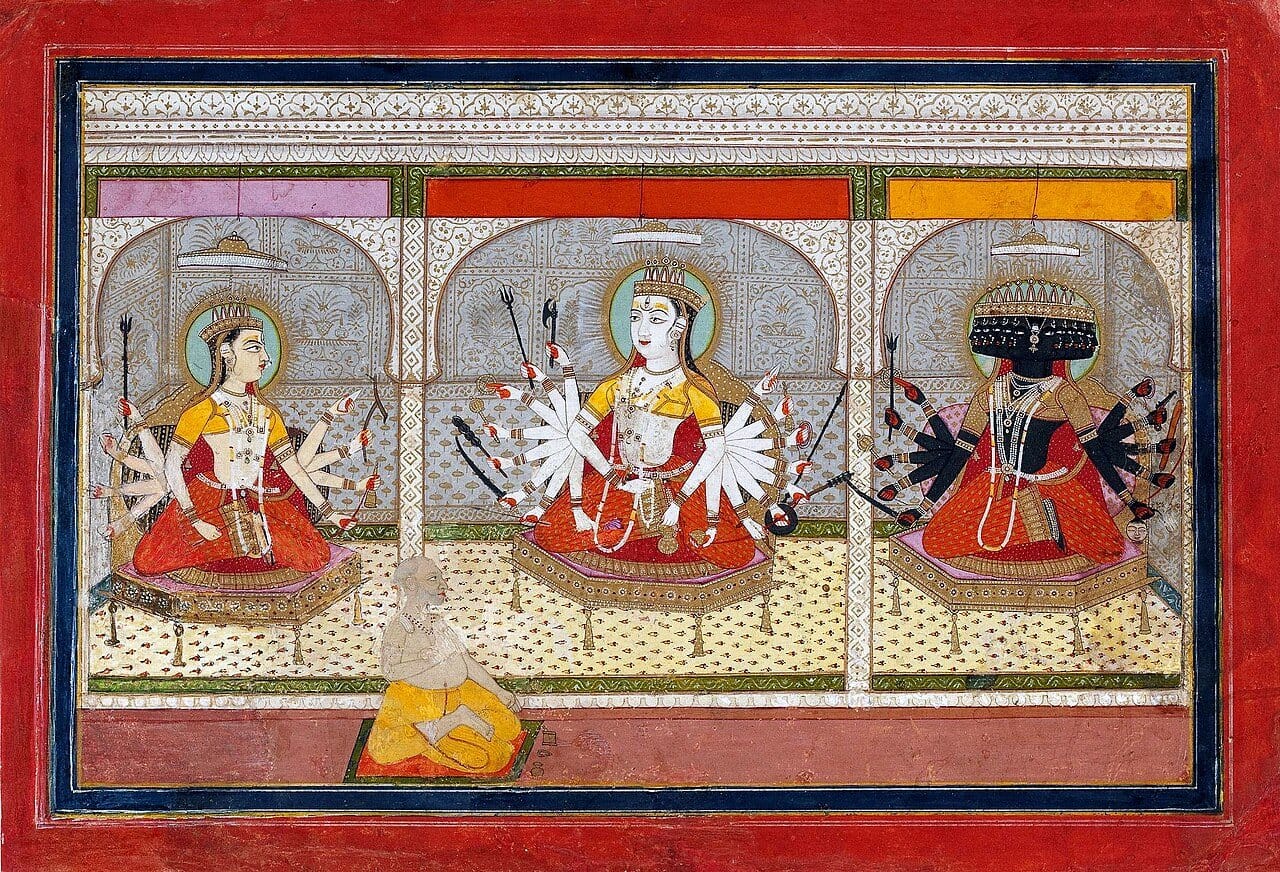
When Maharaja Sawai Jai Singh II founded Jaipur in 1727, he designed the city not merely as a fortified capital, but as an earthly reflection of cosmic order. The Kachwaha rulers had deep ancestral ties to Braj: Raja Man Singh I had built the monumental red sandstone Govindadeva Temple at Vrindavan in 1590. When religious persecutions escalated in the late 17th century, the Kachwahas transferred the sacred deity of Govindadevaji directly to their heartland, installing him inside the City Palace complex itself.
In Jaipur, court painting did not develop as an isolated court pastime. It was a direct extension of temple liturgy and royal devotion. The royal workshop, known as the Suratkhana, attracted master artists from Mughal Delhi and regional Rajasthan. Under Sawai Pratap Singh (r. 1778-1803), a poet-king who wrote passionate Braj Bhasha lyrics under the name Brijnidhi, the atelier experienced its greatest golden age. Jaipur artists abandoned small, private album folios to paint monumental, wall-scale cloth tapestries, creating a grand public stage for Radha and Krishna.
Visual Grammar & Iconography
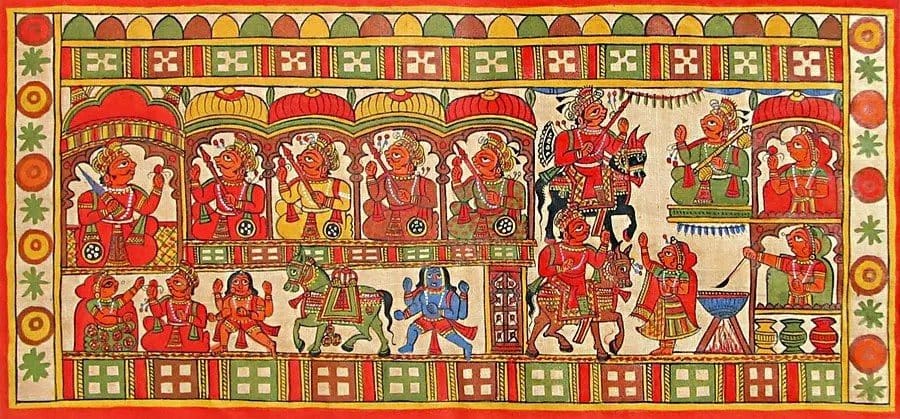
Jaipur painting is characterized by architectural symmetry, expansive scale, and vibrant courtly richness:
- The Concentric Rasa-Mandala: Jaipur’s definitive visual triumph is the large-scale Maha-Raas. Unlike intimate Pahari groves, Jaipur composes the dance on a grand scale: a vast dark green circular terrace where dozens of identical pairs of Krishna and dancing gopis wheel in flawless radial symmetry around Radha and Krishna at the center.
- The Regal, Volumetric Profile: Figures are robust, tall, and majestic. Faces feature large, open almond eyes (chashm), rounded chins, sharp noses, and soft pink shading around the eyes and cheeks. Radha is depicted in rich, voluminous gathered skirts (ghaghras), embroidered bodice (choli), and transparent gold-bordered veils that bell outward with physical movement.
- Architectural Grandeur: Scenes are frequently framed by pristine white marble balustrades, cusped Mughal-Rajput arches, fluted columns, and fountains spurting rosewater, situating the divine play of Braj within the palace gardens of Jaipur.
- The Brilliant Saturated Palette: Jaipur avoided dark, somber tones. The ground glows with bright vermilion, saffron yellow, emerald green, and deep indigo, finished with heavy applications of burnished gold leaf on jewelry and palace cornices.
Material Anatomy & Process
The creation of Jaipur paintings, particularly large ceremonial hangings, required specialized studio craft:
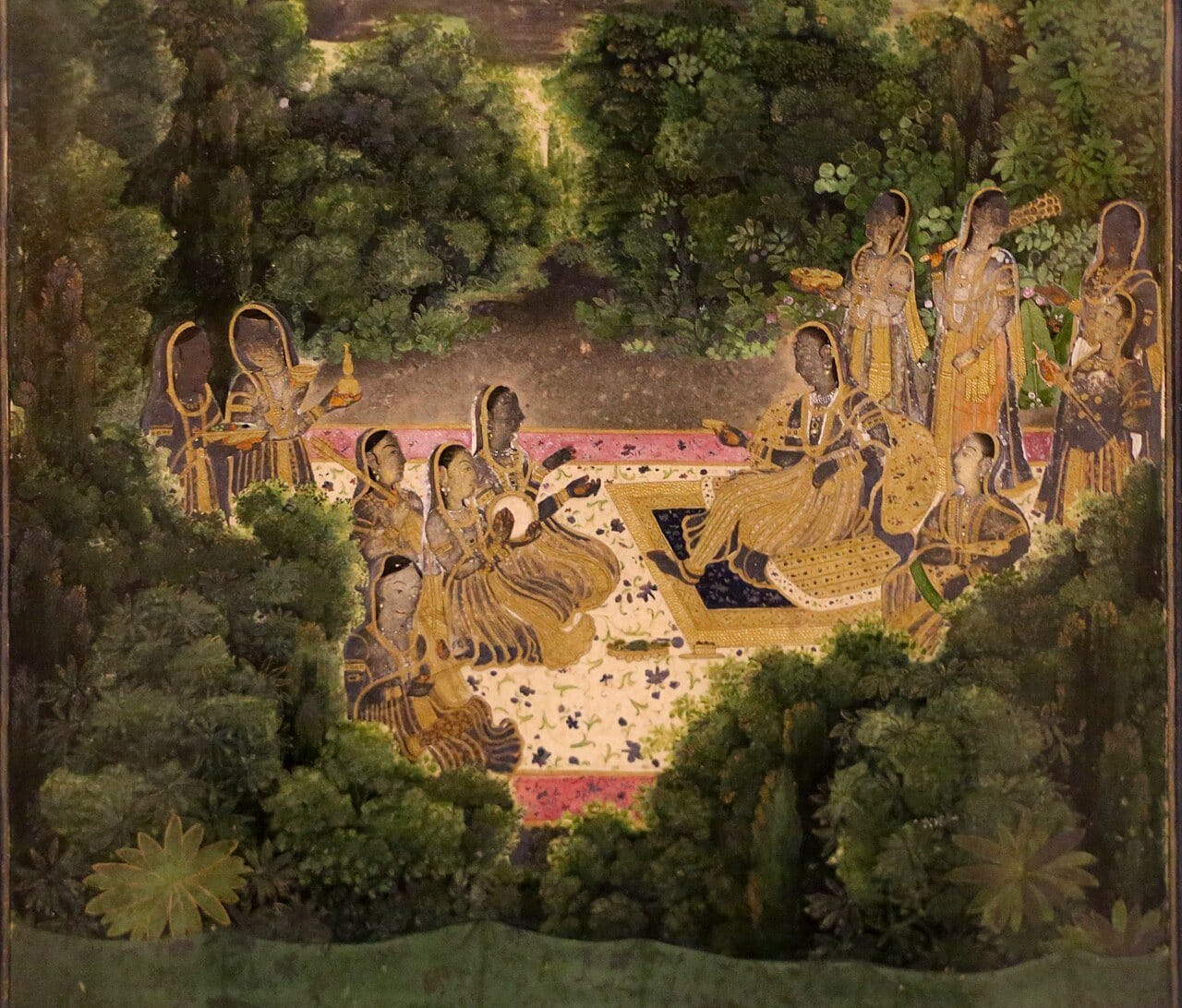
- Heavy Supports (Wasli & Cloth): For standard folios, artists layered thick sheets of handmade paper from the neighboring town of Sanganer, burnishing them with smooth agate stones. For festival paintings, heavy handloom cotton was sized with rice starch and white clay, creating a sturdy cloth ground capable of carrying heavy mineral pigments without cracking.
- Mineral Pigment Mastery
- Red: Pure cinnabar (hingula) and red lead (sindoor).
- Yellow: Local peori (warm yellow clay) and raw orpiment (haritala).
- Green: Copper verdigris (zangar) and crushed malachite.
- White: High-grade Makrana marble dust and zinc white.
- Gold: Real gold leaf (vark) and powdered shell gold (tila), burnished with jade pens to create raised, gleaming textures.
- The Division of Labor in the Suratkhana: Large compositions were executed by multiple specialists: the ustad (master) drew the master cartoon, while junior painters applied flat color fields, executed floral borders, and painted delicate facial features.
The Literary & Spiritual Roots
Jaipur's courtly art was driven by Vaishnava literature and the royal verses of the Kachwaha kings:
- The Verses of Brijnidhi: Maharaja Sawai Pratap Singh composed thousands of devotional songs dedicated to Radha and Govindadevaji under his pen name Brijnidhi. His court painters illustrated these verses directly, depicting the king as an humble attendant standing before the divine lovers.
- The Gita Govinda & Rasikapriya: The court ateliers produced lavishly illustrated sets of Jayadeva’s Gita Govinda and Keshavdas’s Rasikapriya, codifying the emotional states of love (Nayika Bheda) with regal poise.
- The Theology of Royal Seva: In Jaipur, devotion was practiced with imperial honor. Krishna was not viewed simply as a wandering forest cowherd; he was the divine emperor (Thakurji) of Jaipur, and the Maharaja ruled merely as his prime minister (diwan).
Heritage, Lineage & Field Notes
- Master Lineages: The Jaipur Suratkhana was dominated by celebrated masters like Sahibram, famous for his life-size portraits and devotional cartoons, and Ramji Das, who directed the painting of expansive mythological cycles.
- The Living Heritage at City Palace: The historic Suratkhana collections remain preserved inside the Maharaja Sawai Man Singh II Museum within the City Palace of Jaipur, housing rare cartoons, pichwais, and royal albums.
- Key Archival Repositories
- City Palace Museum, Jaipur: The primary repository of monumental Jaipur cloth paintings and Govindadeva folios.
- National Museum, New Delhi: Masterworks of 18th-century Jaipur Rasa-Mandala compositions.
- Albert Hall Museum, Jaipur: Archival collections of 19th-century Jaipur court art and illuminated manuscripts.
In Jaipur, devotion laid aside rural modesty to put on royal silk and gold. It welcomed Krishna into the palace, proving that the love of Braj was sovereign enough to command an entire empire.