The Origin & Regional Context
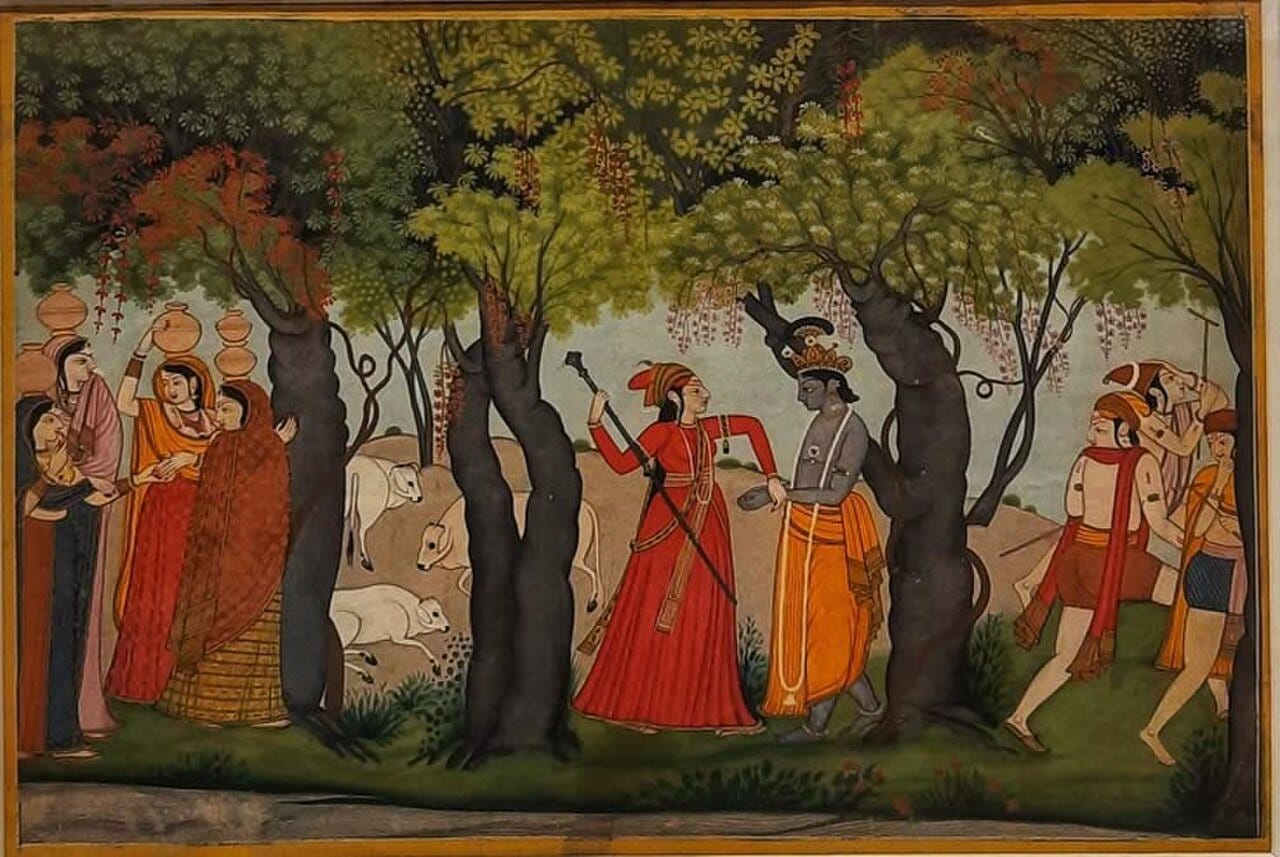
Perched high in the rugged Shivalik ranges along the roaring Alaknanda River, the kingdom of Garhwal was long protected by sheer vertical terrain. In 1658, Mughal prince Suleiman Shikoh sought political refuge at the court of Raja Prithvi Pati Shah in Srinagar (Garhwal). The prince brought an entourage of painters, notably Sham Das and his son Har Das.
While the prince soon returned to his fate, the painters remained in the mountain kingdom, establishing a hereditary artistic lineage that culminated four generations later in Mola Ram (1743-1833). Mola Ram was simultaneously a courtier, a mystic, a classical poet, and a master painter. Under his brush, the imported Mughal technical discipline was entirely dissolved into the emotional fervor of Braj. In Garhwal, the pastoral pastures of Vrindavan were lifted straight into high Himalayan valleys, where pine forests and rocky crags became the backdrop for Radha’s devotion.
Visual Grammar & Iconography
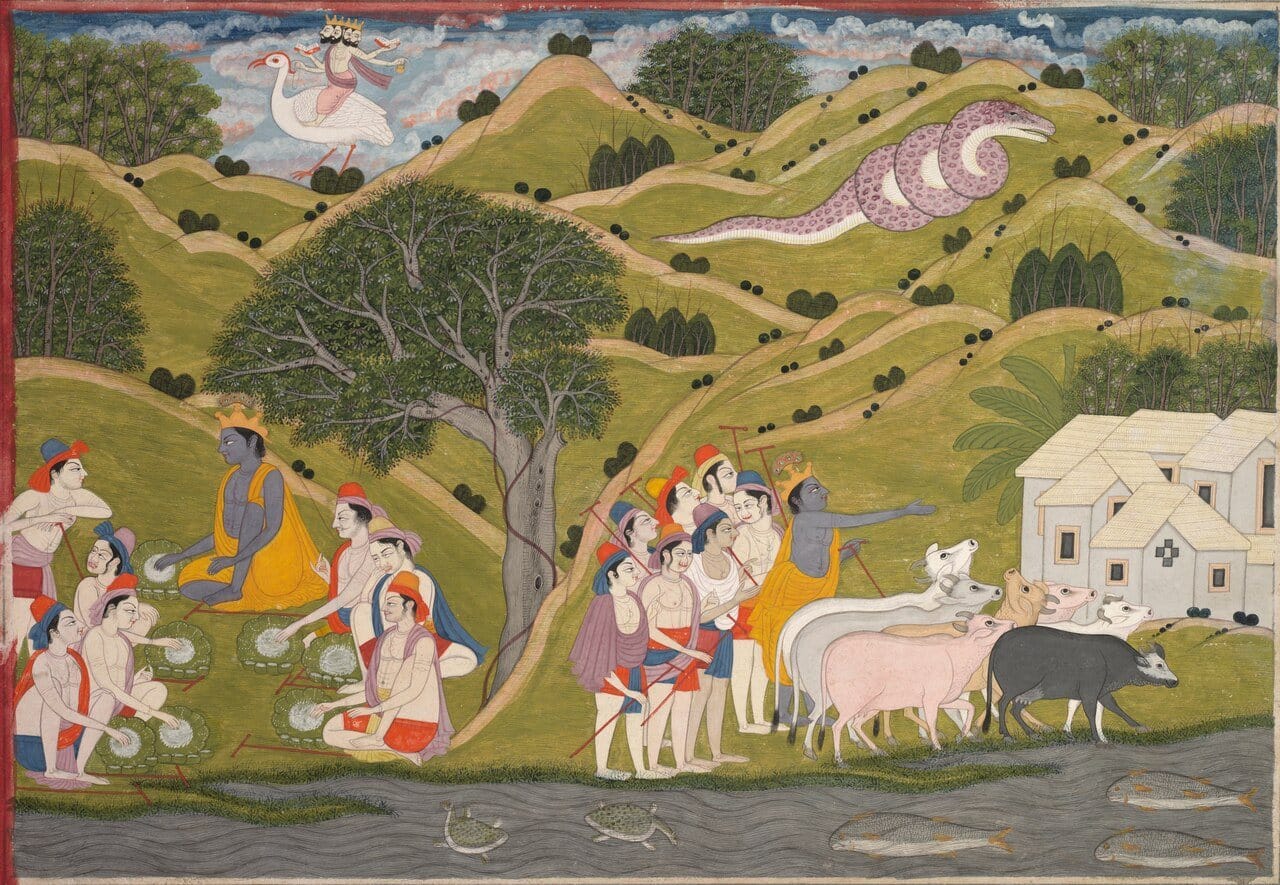
Garhwal painting possesses an identifiable emotional intimacy, setting itself apart from Kangra and Guler through specific visual markers:
- The Slender, Elongated Silhouette: Figures in Garhwal are remarkably slender with narrow waists, graceful postures, and long, elegant limbs. Radha is depicted with an arched, high forehead, delicate lotus eyes, a straight nose, and a soft, curving mouth that conveys unyielding resolve.
- The High Mountain Horizon: Garhwal masters framed their scenes with towering mountain contours. Blue-gray crags and rolling alpine ridges rise toward the upper third of the page, making the human drama below feel protected and intimate within the mountain cradle.
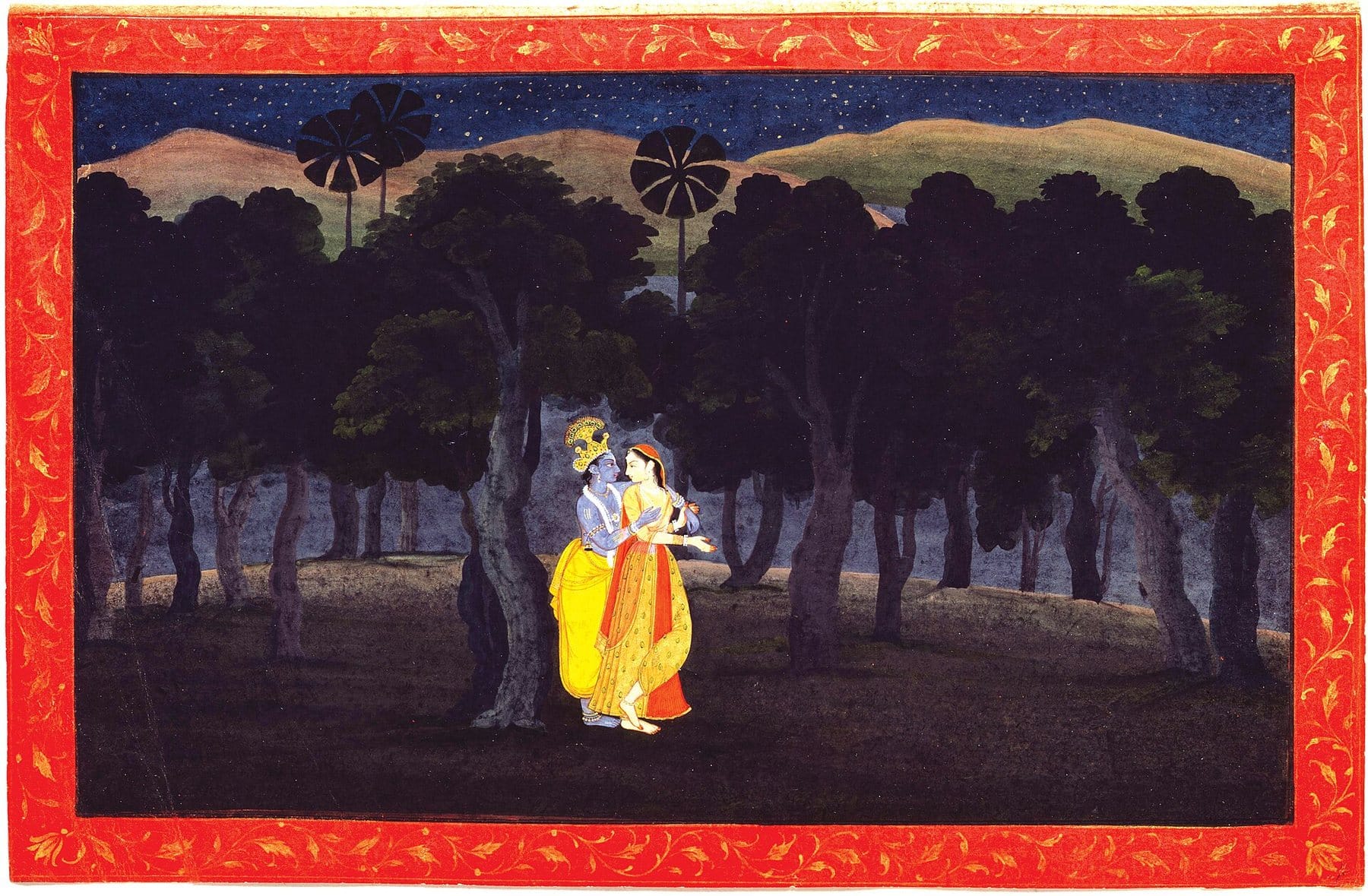
- The Dynamic Drama of Night (Abhisarika): The definitive masterpiece of Garhwal is the Abhisarika Nayika (the heroine who steps into the terrifying night to meet her beloved). She walks barefoot through dark forests teeming with lightning, howling winds, coiled tree roots, and slithering serpents, her white veil glowing like moonlight against the dark green wilderness.
- Flowering Trees as Emotional Accents: Trees are not decorative backdrops. Sinuous, flowering creepers wind tightly around ancient tree trunks, symbolizing the unbreakable bond between Radha and Krishna.
Material Anatomy & Process
The creation of a Garhwal miniature followed the rigorous traditional studio techniques of the Pahari hills:
- The Wasli Board: Multiple layers of handmade Sialkoti paper were bonded with cooked starch paste, treated with neem water to resist insects, and rubbed with smooth agate burnishers until the ground gleamed like polished bone.
- The Fine Himalayan Brush: Master outlines were executed using ultra-fine brushes made from the selected hairs of mountain squirrels or the downy feathers of birds, allowing painters to trace continuous lines across undulating paper.
- Mineral and Organic Palette
- Blue: Crushed lapis lazuli, washed to produce moody nocturnal skies and Krishna's luminous complexion.
- Green: Local mountain terra verde and copper verdigris for deep pine forests and winding creepers.
- Gold & Silver: Real shell gold (purified gold ground into gum) and silver leaf, burnished directly into jewels, crowns, and lightning flashes.
- Black: Lamp soot harvested from sesame oil wicks, delivering deep, velvety nocturnal fields.
The Literary & Spiritual Roots
Garhwal painting was deeply literary, created by artists who were poets themselves:
- Mola Ram's Own Poetry: Uniquely among Pahari artists, Mola Ram inscribed his own Braj Bhasha verses directly onto the top margins of his folios. His poetry explored Viraha (separation) and the courage of unconditional love, explaining the emotional action taking place within the image.
- Bhanudatta's Rasamanjari: The classical Sanskrit classifications of the Nayika Bheda were painted extensively, examining every delicate shift of Radha’s heart from timid expectation to fearless surrender.
- The Rasa of Brave Devotion (Abhisara): Garhwal celebrated the sheer courage of Bhakti. When Radha walks into the pitch-black mountain woods, it is an allegory of the individual soul casting aside fear, shame, and worldly opinion to unite with the divine.
Heritage, Lineage & Field Notes
- The Mola Ram Lineage: Following the Gurkha invasion of Garhwal in 1804 and the shifting of the capital to Tehri, court patronage contracted sharply. Mola Ram’s descendants preserved hundreds of family sketches and finished masterworks in Srinagar until art historian Mukandi Lal brought them to international light in the 20th century.
- Key Archival Repositories
- Hemvati Nandan Bahuguna Garhwal University Museum, Srinagar (Garhwal): Houses original family artifacts and paintings of Mola Ram.
- Bharat Kala Bhavan, Varanasi: Exceptional collection of Garhwal Nayika paintings.
- National Museum, New Delhi: Masterworks depicting Radha and Krishna under mountain skies.
- Victoria and Albert Museum, London: Dispersed 18th-century Garhwal folios.
In Garhwal, the painters proved that genuine love does not wait for a clear sky. It steps directly into the thundering night, guided entirely by the light of its own devotion.