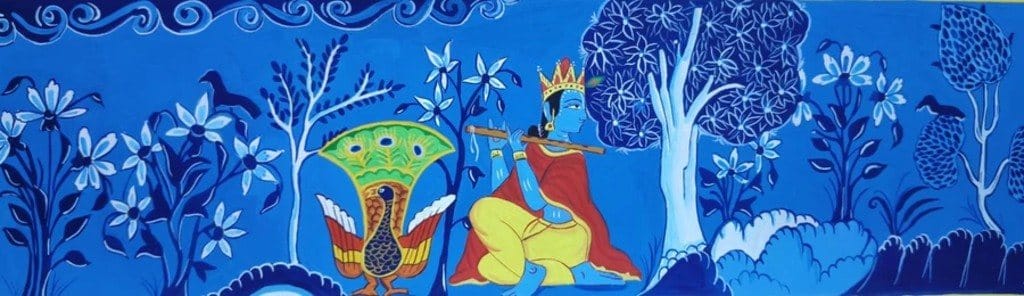
The Origin & Regional Context
Far to the east, along the misted floodplains of the mighty Brahmaputra River, the devotional poetry of Braj found a distinctive, austere visual language. In the 15th and 16th centuries, the saint-reformer Srimanta Sankardev founded the Ekasarana Dharma, a monotheistic Vaishnava movement that bypassed complex ritualism in favor of pure devotion, congregational chanting (Nama-Kirtana), and sacred dance.
Central to this movement was the creation of the Sattra: sprawling monastic centers built on river islands and forested plains, most notably on the island of Majuli. Inside the central prayer hall (Namghar), there were no stone idols on the altar. At the spiritual heart of the hall stood the Guru Asana (a multi-tiered wooden throne) holding only a single sacred manuscript: the Bhagavata Purana. To preserve and teach these texts, monk-artists (Bhakat) developed a unique manuscript painting tradition known as Sattriya Painting or the Chitra Bhagavata tradition. In Assam, Braj was illuminated on tough, parchment-like tree bark, created to withstand the fierce tropical floods of the valley.
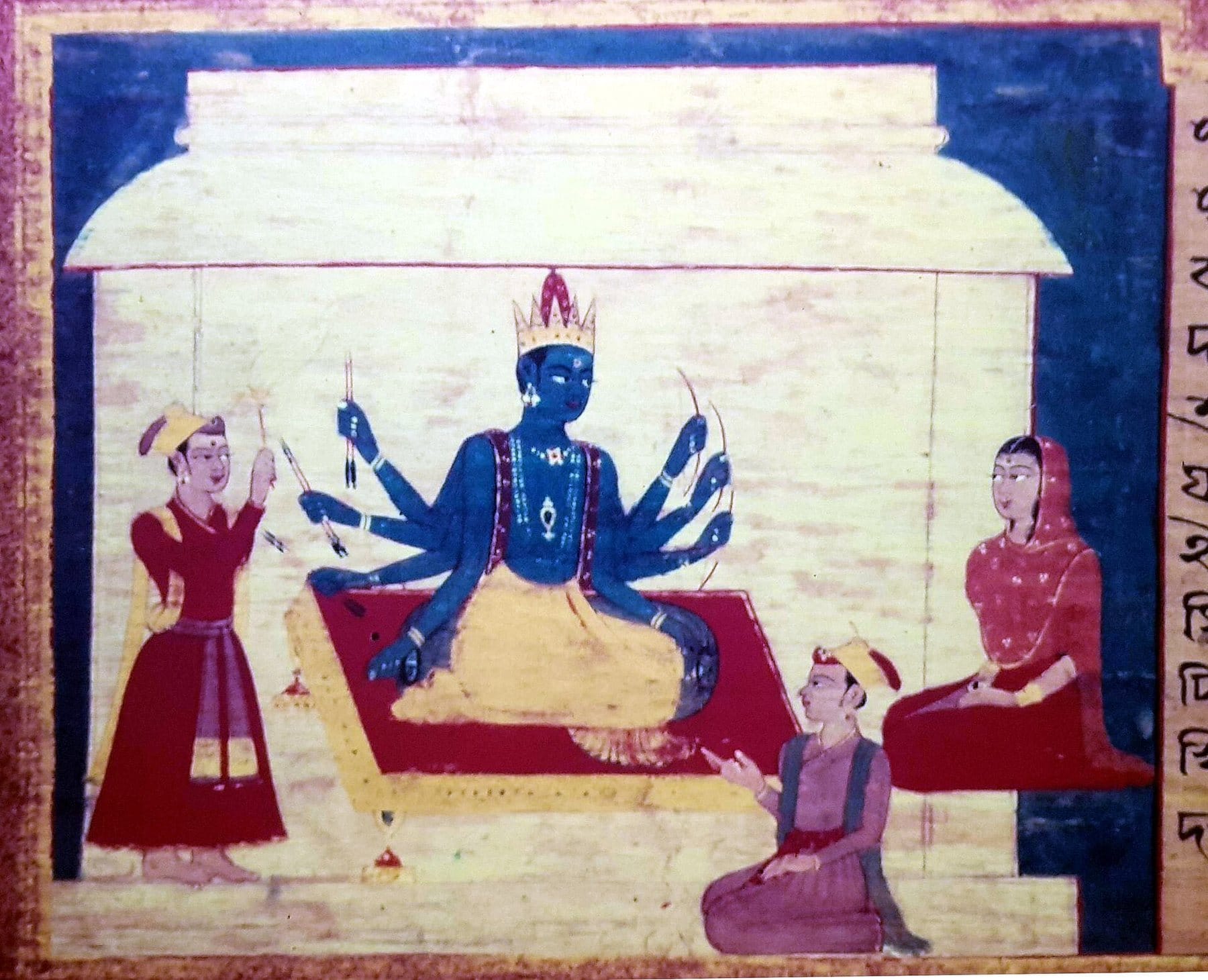
Visual Grammar & Iconography
Sattriya manuscript painting possesses a graphic, rhythmic directness rooted in folk theatre and monastic discipline:
- The Horizontal Architectural Strip: Compositions are arranged on narrow, elongated horizontal panels. The narrative unfolds like a cinematic scroll, separated by simple wooden pavilions with stepped, pointed gables (chou-chala) that mirror local Assamese thatched architecture.
- Dynamic, Dramatic Postures: Figures do not stand in quiet repose; they dance with the energetic steps of classical Sattriya dance and Bhaona (traditional theatrical performances). Krishna moves with angled elbows, bent knees, and expressive, rhythmic gestures (mudras).
- The Graphic Profile & Almond Eyes: Characters are drawn in sharp profile with strong, sloping foreheads, pointed chins, and large, clear almond-shaped eyes that gaze outward with fierce devotion and dramatic intensity.
- Monochrome Ground Compartments: Like early western Indian and Mewar manuscripts, scenes are framed against solid bands of saturated, unmixed color: bright red vermilion, mustard yellow, and deep forest green. These flat fields isolate the divine characters and make the action instantly legible across the candlelit prayer hall.
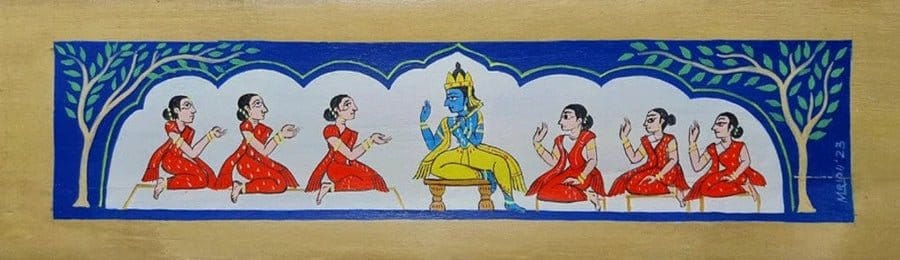
Material Anatomy & Process
The survival of these manuscripts across centuries of tropical rain is an extraordinary achievement of organic chemistry:
- The Sacred Support (Sanchi Pat): Assamese manuscripts were never made on fragile paper or palm leaves. They were crafted from the bark of the Sanchi tree (Aquilaria agallocha, the agarwood tree). Strips of bark were stripped from mature trees, cured in mountain dew, boiled in water to extract natural resins, scraped smooth with stones, and treated with a paste of crushed pulses and turmeric. The resulting sheets are tough, pliable, and naturally resistant to termites and water.
- The Natural Ink (Mahi): The black ink used for text and outlines, known as Katha-Mahi, was manufactured using a secret traditional recipe combining urine of domestic cattle, crushed bark of the Bhomora tree, Indian gooseberry (Amla), and carbon soot, left to mature inside earthen pots with a piece of iron. The ink creates an indelible, waterproof black line that does not fade over five centuries.
- The Pure Mineral Palette (Hengul-Haital)
- Red: Pure cinnabar mineral (Hengul), ground by hand for days to achieve deep scarlet brilliance.
- Yellow: Raw orpiment stone (Haital), producing a luminous golden-yellow for Krishna’s garments.
- Blue: Natural indigo (Nil) extracted from wild forest shrubs.
- White: High-grade white clay (Dhal-Mati) collected from deep riverbeds.
- Binding Medium: Sticky sap of the wood-apple tree (Bel) and raw duck-egg white.
The Literary & Spiritual Roots
Sattriya painting is directly fused with the literary masterpieces of Srimanta Sankardev and his disciple Madhavdev:
- The Chitra Bhagavata: The primary text illustrated across the Sattras was Sankardev's Assamese verse translation of the Tenth Book of the Bhagavata Purana. The paintings brought to life the childhood escapades of Krishna in Gokula, the subduing of forest demons, and the pastoral warmth of the cowherd settlements.
- The Borgeets (Songs of the Soul): Sankardev and Madhavdev composed hundreds of devotional hymns in Brajavali (a poetic language blending Maithili, Assamese, and Braj Bhasha). These songs describe the beauty of the dark child of Braj, and monks recited them inside the prayer halls while turning the painted folios of the bark manuscripts.
- The Theater of Devotion (Bhaona): In Assam, painting and theatre are inseparable. The costumes, demon masks, and character postures in Sattriya manuscripts are identical to those worn by actors in village Bhaona plays, creating a complete sensory environment where scripture, theatre, and visual art become one single act of prayer.
Heritage, Lineage & Field Notes
- The Living Monasteries of Majuli: The world’s largest river island, Majuli, remains the beating heart of this tradition. Sattras like Kamalabari, Auniati, and Natun Samaguri continue to house ancient illuminated manuscripts, preserved in carved wooden chests (Peti) wrapped in layers of wild Muga silk.
- The Monastic Scribal Guilds: The art was preserved by celibate monks known as Likhaks (scribes) and Khanikars (painters and woodcarvers), who viewed the illumination of a manuscript not as an artistic career, but as lifelong devotional service (Sadhana).
- Key Archival Repositories
- Department of Historical and Antiquarian Studies (DHAS), Guwahati: Houses rare historical Sanchi-pat manuscripts.
- Auniati Sattra Museum, Majuli: Remarkable collection of early Chitra Bhagavata folios and ceremonial artifacts.
- National Museum, New Delhi: Master illuminated Assamese manuscripts of the Krishna narrative.
On the banks of the Brahmaputra, the memory of Braj was carved into the bark of the forest itself. It did not fade under the monsoon, proving that true love, like the river, only runs deeper with time.