The Origin & Regional Context
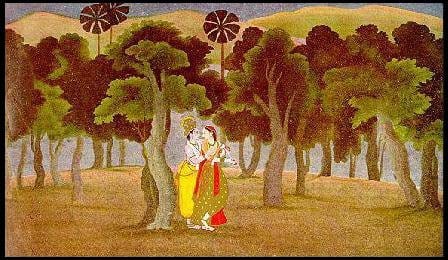
Following the decline of the Mughal capital and the sack of Delhi by Nadir Shah, master painters migrated into the Shivalik foothills of the Punjab Plains. In the sheltered valley of Kangra, under the legendary patronage of Maharaja Sansar Chand (r. 1775-1823), Pahari miniature painting reached its supreme aesthetic summit.
Sansar Chand was a devoted Vaishnava who ascended the throne at the age of ten and envisioned his court as an earthly Vrindavan. He invited and supported master painters from the lineage of Pandit Seu, most notably the sons and nephews of Nainsukh and Manaku. In Kangra, miniature art shed the architectural stiffness of Mughal portraiture and the fierce folk geometry of early Basohli. Here, the pastoral legends of Braj dissolved into the natural rhythms of the Kangra Valley, where mountain streams, willow trees, and gentle monsoon clouds became the living backdrop for divine love.
Visual Grammar & Iconography
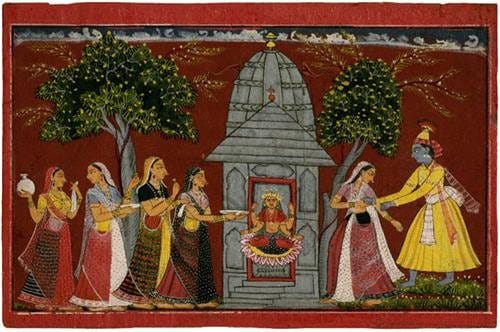
Kangra painting is defined by rhythmic flowing lines, translucent atmospheric perspective, and pure emotional tenderness:
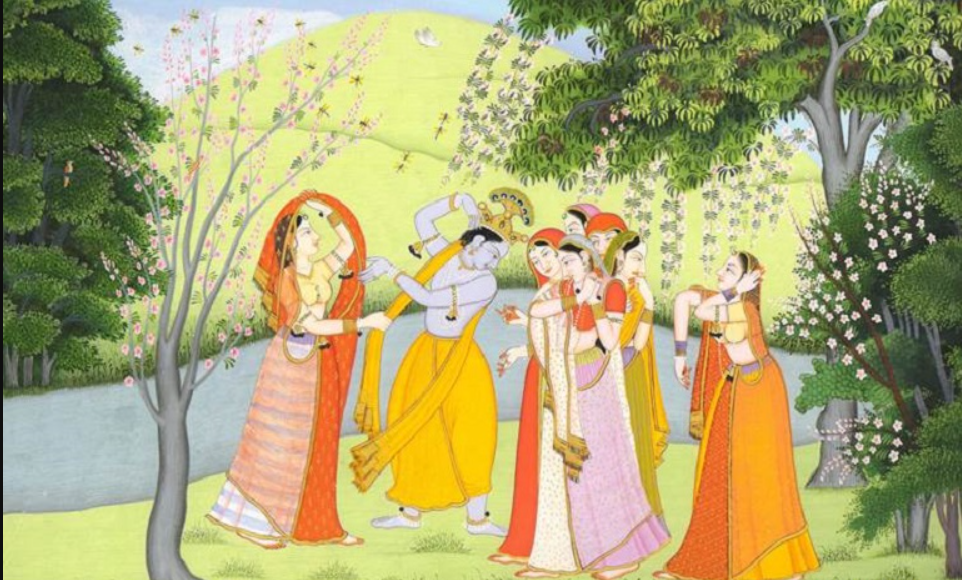
- The Classical Ideal Profile: Radha and the gopis are painted with serene, pure facial contours: a straight nose running continuous with the forehead, delicate lotus-petal eyes (padma-netra), gently rounded cheeks, and modest downcast glances that express sacred intimacy (shringara).
- Sinuous, Flowing Linework: The draftsmanship of Kangra relies on an unbroken, lyrical contour line executed with breathtaking control. The drapery of gossamer veils (odhanis) and silk ghaghras clings softly to the body, curving in harmony with the natural posture of the figures.
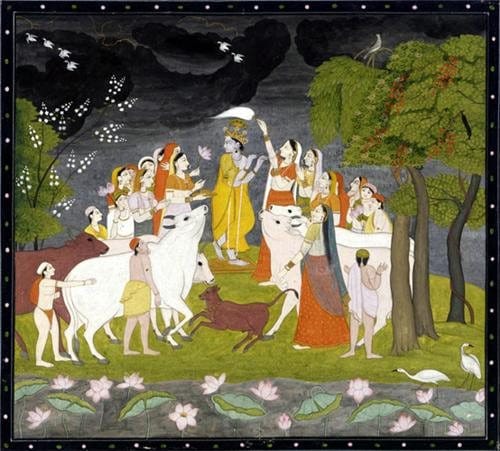
- Atmospheric Nature and Verdant Greens: Landscapes are soft and rolling. The hills are washed in subtle layers of sap green, moss green, and olive, punctuated by blossoming fruit trees, winding riverbanks with cranes, and pale distant mountain horizons veiled in mist.
- Nocturnal and Monsoon Moods: The Kangra school excelled in rendering dramatic natural light: lightning forks illuminating a pitch-black forest, silver raindrops falling against slate-gray clouds, and the warm, candlelit interiors of palace pavilions.
Material Anatomy & Process
The technical refinement of the Kangra atelier required weeks of patient preparation:
- Burnished Sialkoti Wasli: Master artists used layers of smooth handmade paper produced from wild mountain bast fibers, laminated with fine rice-starch paste mixed with insect-repelling neem extract, and burnished with smooth river agates until the ground felt like cold marble.
- Squirrel-Tail Brushes: The microscopic precision of Kangra outlines was executed using brushes crafted from the downy hairs of Himalayan squirrel tails, bound into bird quills with fine silk thread.
- Pure Botanical and Mineral Alchemy: The palette included:
- Green: Delicate mixtures of copper verdigris (zangar) and local mountain terra verde (sang-i-sabz).
- Yellow: Warm peori clay and bright mineral orpiment (haritala).
- Blue: Purified ultramarine extracted from crushed lapis lazuli for Krishna’s body and nocturnal skies.
- White: Calcined conch shells and lead white, layered to render pearls and marble balustrades.
- Gold: Pure leaf gold ground into gum water, burnished to give a satin, non-metallic luster to jewelry and halos.
The Literary & Spiritual Roots
Kangra painting was an inseparable visual companion to classical Sanskrit and Braj Bhasha poetry:
- Jayadeva’s Gita Govinda: The Kangra Gita Govinda suite of 1780 is considered one of the greatest masterworks of Asian art, illustrating the twelve cantos of separation, longing, and joyous reconciliation in the forest of Vrindavan.
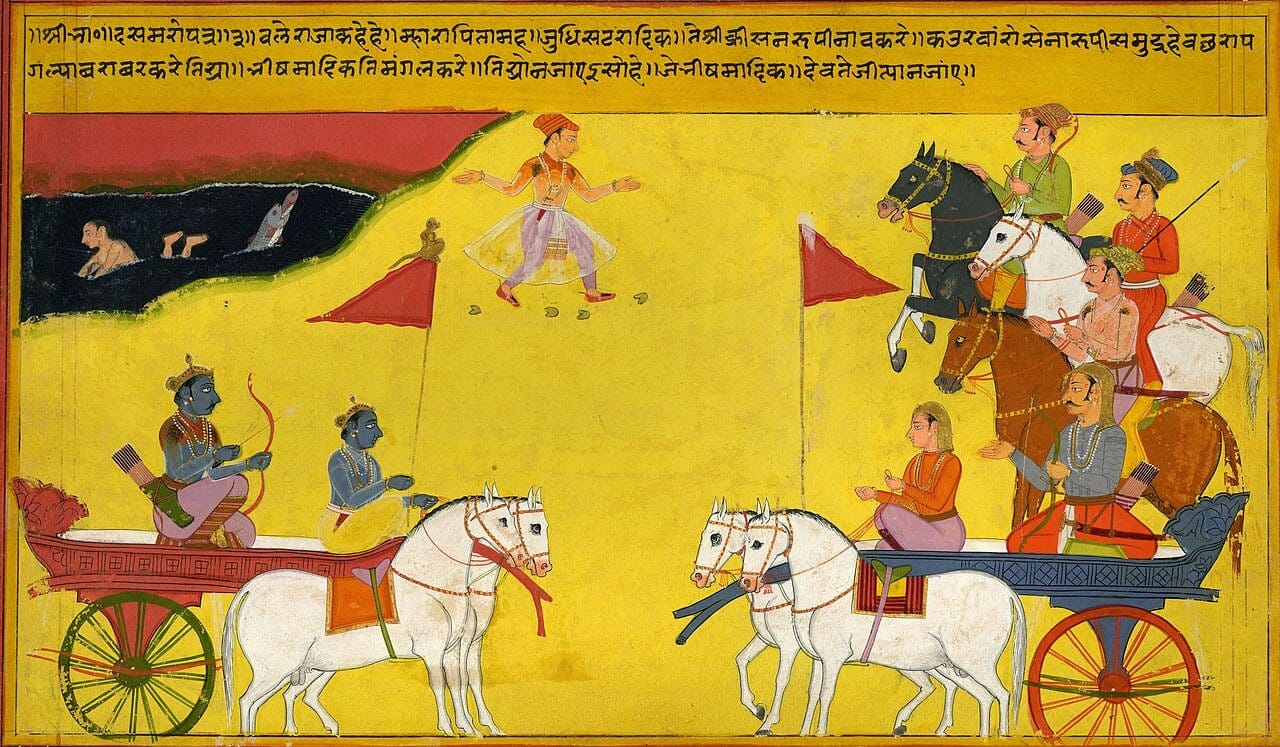
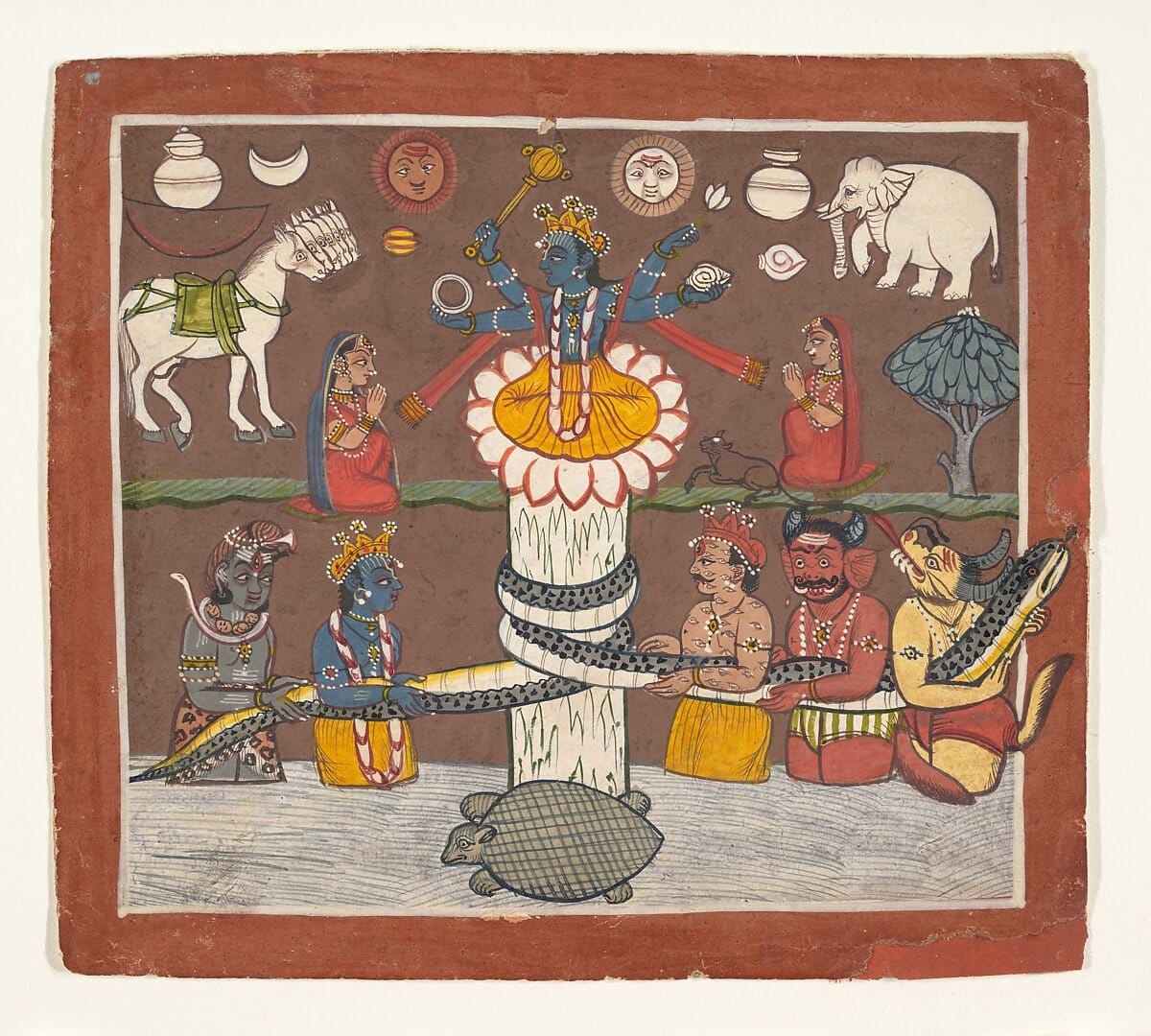
- The Bhagavata Purana: The tenth book of the Bhagavata was illustrated in vast, multi-folio cycles, capturing Krishna’s childhood in Gokula, the lifting of Mount Govardhan, and the ecstatic dance of the Rasa-Mandala.
- The Nayika Bheda of Keshavdas: Court artists translated the intricate emotional categorizations of the Rasikapriya, examining the psychology of Radha through every stage of love.
Heritage, Lineage & Field Notes
- The Family of Manaku and Nainsukh: The signature genius of Kangra painting belongs to the descendants of Pandit Seu: Fattu, Khushala, Gaudhu, and Manaku, whose collaborative family workshop produced the finest royal manuscripts.
- The 1905 Earthquake: The great Kangra earthquake destroyed the ancient palaces of Kangra and Tira Sujanpur, but royal family collections and dispersed temple folios survived in private hands and public institutions.
- Key Archival Repositories: Major collections include:
- Government Museum and Art Gallery, Chandigarh: The world's finest public collection of Kangra masterworks.
- National Museum, New Delhi: Renowned Kangra Bhagavata and Gita Govinda series folios.
- Bharat Kala Bhavan, Varanasi: Important historical leaves from Sansar Chand's royal atelier.
- Victoria and Albert Museum, London: Premier historical Pahari collections.
In Kangra, the artists proved that divine love is not distant from creation. By painting Radha and Krishna among their own mountain trees, they brought the eternal landscape of Braj into the living heart of the earth.